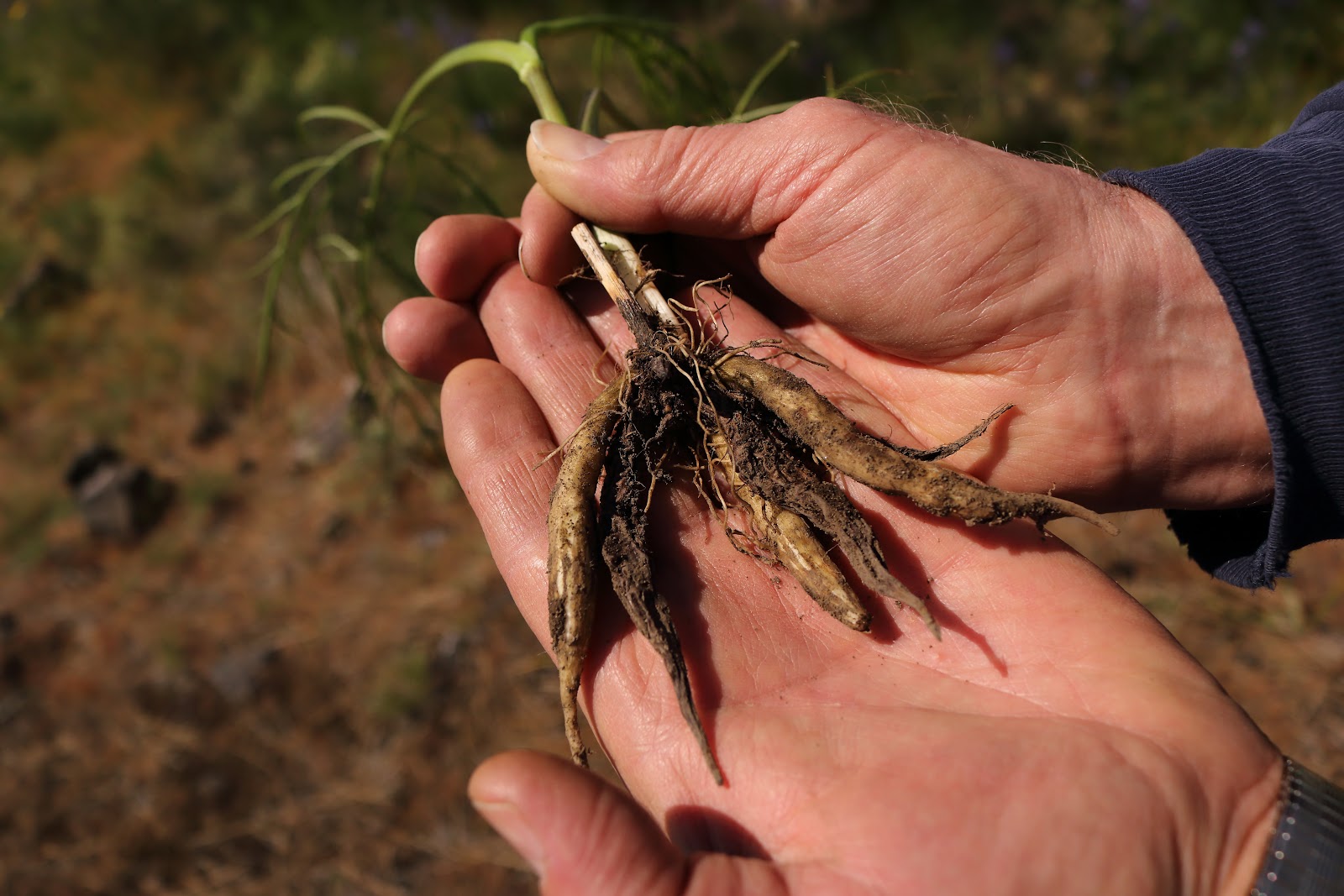
Lately, I have been curious if anyone still eats lomatium macrocarpum. I apologize that I don't know any of the traditional names for this plant, but many of our ethnobotany books claim that it's edible. Please let me know if you know anything about this root.
Showing posts with label Ethnobotany. Show all posts
Thursday, May 07, 2015
Sunday, May 03, 2015
Camas Therapy
My friend Stanton brought me to Drumheller Springs to see the camas in full bloom. I'm still not strong enough to actually dig the roots, but I didn't want to miss a visit with the flowers. Our short walk was my physical therapy for the day, but seeing the native plants was therapy for my soul.
La Terapia de Camasia
Mi amigo Stanton me llevó a las Mantiales Drumheller para ver la camasia en su floración total. Aún no tengo fuerza como para excavar las raíces, pero no quería perder una visita con las flores. Nuestra caminata breve sirvió como terapia física, pero el acto de ver las plantas nativas me sirvió de terapia para el alma.
As far as I can tell, no one has every translated camas into Spanish. If anyone knows, please tell me, but for now, I think I'll call camas by an adaptation of its Latin name. In Latin, the plant is called cammassia quamash, so in Spanish, I will call it: la camasia.
Según puedo ver, nadie ha traducido la palabra camas al español. Si alguién lo sabe, por favor dígamelo. Pero por ahora pienso que llamaré la camas por una adaptación de su nombre latín. En latín, la planta se llama cammassia quamash. Por tanto, en español, la llamaré: la camasia.
The camas flowers will soon begin to wilt. The weather has changed so much; I think the flowers are several weeks early.
Pronto las flores de camasia empezarán a marchitar. El clima ha cambiado tanto; pienso que las flores han llegado temprano por varias semanas.
A ladybug in the camas flower.
Un ladybig entre la flor de camasia.
This plant is often called Indian carrot or yampa (perideridia gairdneri).
Frecuentemente, esta planta se llama "zanahoria indígena" o yampa.
From left to right:
Wild onion.
Indian carrot (yampa).
Camas.
Indian carrot (yampa).
De izquierda a derecha:
Cebolla silvestre.
Zanahoria indígena.
Camasia.
Zanahoria indígena.
The roots of Indian carrot.
Las raíces de zanahoria indígena.
Some of the bitterroots (Lewisia rediviva) were beginning to bloom.
Algunas de las raíces amargas empiezan a florecer.
Lomatium trinernatum with camas.
Lomatium triternatum con la camasia.
Lomatium trinernatum flowers remind me of tiny galaxies.
Las flores de lomatium trinernatum me parecen pequeñas galaxias.
Arrowleaf balsamroot (balsamorhiza sagittata).
El nombre de esta flor se traduce literalmente al español como "hoja flecha raíz balsámico."
The balsamroot flowers are just beginning to wilt.
Las flores de raíz balsámica están empezando a marchitar.
Saturday, October 25, 2014
Black Moss
On my drive this afternoon, I passed a beautiful tamarack tree draped in long strands of black moss. I can't even begin to describe the happiness I felt to see them. The moss seemed to say, "Where are your fellow moss pickers?"
Monday, June 30, 2014
Earth Oven
Many years ago, our Indian ancestors survived by harvesting wild foods like camas, wild onions, and black moss. They often spent weeks in the field digging, cleaning, and processing the foods, then they baked the foods for several days in a traditional earth oven. Nowadays, we can easily buy all our food from the supermarket, but many of us maintain the old food gathering as a way of keeping our ancestral connections alive.
When we cook traditional foods in the ground, we have to tend the surface fires for at least two or three days. During that time, friends and family gather to visit and tell stories.
Francis is my fellow cook. A long time ago, only women were allowed to cook the Indian foods, but the grandmothers in our family have given their blessing for us to cook.
Sunset during one of our cooking days.
One of the best parts of cooking food in the ground is when the elders of our family come to watch. They sit around the fires and tell stories from their personal histories. They're such beautiful people! I feel blessed to have such wonderful elders.
This year the camas came out of the oven just right.
A cross section of camas showing all the layers.
My niece and nephew always help with the baking.
The brown camas just as it came out of the oven.
The black moss was flavored with wild onions.
Black Moss
This year, we found large quantities
of black moss for our yearly pit bake.
Much of the moss grows up high,
way beyond our reach.
Moses Road.
Wild rose during our black moss expedition.
Our black moss crew.
Monday, June 23, 2014
Second Day of Camas
We went back to the camas fields near Spangle for a second day of digging.
As I was digging, a song sparrow fluttered away from my peceʔ and perched on a nearby fence-line. She scolded us, which alerted us to the presence of her nest. We looked down and found five miniature eggs hidden beneath a cluster of leaves. I took a few pictures and returned the nest to the mother bird.
My auntie Iva arrived part way through the day and shared a hundred stories of the old days - of digging camas as a young girl, preparing the baking pits, and visiting with her grandparents. I could have listened to her all day and more.
Sunset near Spangle.
The first batch of camas cleaned.
Sunday, June 22, 2014
Camas
The camas were as beautiful as ever in the fields near Spangle. They were a little drier than usual, but they were still vibrant and alive. For me, these plants represent tradition, spirituality, and my connection to life. They are part of my extended community in nature.
pcpeceʔ.
itxʷeʔ.
kʷtunt...
xʷeʔit.
Onions
My friend and I dug wild onions by the Spokane River.
Some of the flowers were still pink,
but most had already dried.
The onions were growing in the sand
on the shore of the river.
A view of the Spokane River from above.
Sunday, May 04, 2014
Stinging Nettle
Some friends and I collected stinging nettles this weekend.
Despite their reputation for inflicting pain,
they have strong medicinal properties.
You can also use their fibers to make twine.
The Spokane word for nettles is: c'c'axiʔłp.
The root word is c'ax, meaning to fry in oil.
Is this a reference to the feeling on the skin
after being "fried" by the nettle?
The new growth is sprouting among
the dried stalks of last year.
The dried stalks provide fiber for making twine.
Subscribe to:
Posts (Atom)