st'ulixʷ č nwist (Heavenly Land) performed by Barry Moses in the Spokane language and recorded by Stanton Cobbs at Summit Sound Studio in Tum Tum, Washington - 2016. Translation and back story to come.
Showing posts with label Salish. Show all posts
Showing posts with label Salish. Show all posts
Monday, November 07, 2016


xʷl stem'...?
"Why Will You Wait?" performed by Barry Moses in the Spokane language and recorded by Stanton Cobbs at Summit Sound Studio in Tum Tum, Washington on November 5, 2016. Back story and translation to come.
Sunday, November 06, 2016
čsaxm ʔeymews
"Near the Cross" performed in the Spokane language by Barry Moses and recorded by Stanton Cobbs at Summit Sound Studio in Tum Tum, Washington. Translation and back story to come.
Saturday, November 05, 2016
Red Lake

y'e snyak'ʷqin u wičn łuʔ ikʷil čłq'li.
t nk'ʷuʔ qʷu cuys t in yeyeʔ u
t nk'ʷuʔ qʷu cuys t in yeyeʔ u
t'ey'eʔ łuʔ čłq'liʔ sl'axts.
Tuesday, October 13, 2015
The Kalispel's River at Sunrise

axla hec k'ʷul'stn l' qlispeʔ st'ulixʷs, u lše u hec q'iʔstes łuʔ q'iʔq'iʔmin l' nqlispelišcn xʷl sccmelt. kʷtunt in xmenč łu i sck'ʷul'. nkʷtnaqsm łuʔ qe sck'ʷul'. yec yoʔnunm łuʔ hiqs xstwilšm łuʔ in nqʷlqʷeltn u lšey' m xest xʷl qe sxʷsixʷlt.
in xmenč łu qlispeʔ st'ulixʷs. qʷamqʷmt.
*
Every day I go to Kalispel country, and there I am writing books in the Kalispel language for children. I love my work. Our work is important. I am learning to improve my language so it will be good for our children.
I love the Kalispel country. It is beautiful.
*
Cada día, voy al país Kalispel, y allí estoy escribiendo libros en el idioma Kalispel para niños. Amo mi trabajo. Es importante nuestro trabajo. Estoy aprendiendo a mejorar mi idioma y así será mejor para nuestros hijos.
Amo el país Kalispel. Es hermoso.
Thursday, July 09, 2015
Spokane Language

The other day, I had the good fortune to sit next to the world's leading expert on the Spokane language. We were attending a funeral, but she happened to look down and see my name printed on a bag. This inspired her attention, and she passed me this note to explain the original, long version of my name. From there, she passed me several other handwritten notes - all of them translations of important prayers in our language.
These notes made me feel like the richest man in the world.
Thursday, October 30, 2014
Salish Campaign
Joe Pakootas published a campaign add in the Colville-Okanagan Salish. I'm proud that one of our candidates is representing the Native American vote.
Post by Pakootas for Congress.
Post by Pakootas for Congress.
Sunday, October 26, 2014
sxaslqs

wičn sxaslqs č čsaxm łuʔ sčecuweʔ.
I saw a moose near Wellpinit.
I saw a moose near Wellpinit.

That moose was looking kind of mean in this picture, but I don't think I was in any danger. My camera has a pretty decent zoom lens, so I was actually quite far away.

Saturday, October 25, 2014
sumix

This afternoon, I drove home through Tum Tum and Suncrest. As I passed the pictographs at the base of the hill, I felt the urge to stop. I've probably seen these rock paintings a hundred times, but I always feel drawn to return.
Years ago, the parks department posted a sign with the name sumix near the entrance of the site. Presumably, the name had some reference to the spiritual nature of the rock paintings. However, it was strange that they used a Colville-Okanagan word rather than a Spokane word, considering that the paintings reside well within Spokane territory. In the Colville-Okanagan language, sumix means something like "spirit power." We have a similar word in the Spokane language: sumeš. It makes me wonder who originally created the name. Did a park ranger from 50 years ago simply pick a name that seemed "Indian"? Did someone consult a Colville-Okanagan speaker to name a Spokane historical site? In short, how did a cultural site within the Spokane territory get a Colville-Okanagan name? Does anyone know the story?
In any case, the sign has since been removed.
Saturday, October 11, 2014
unexʷ ckʷinč

Earlier today, I posted several pictures of my daughter wearing a Robin Hood costume and holding a homemade bow. I called the bow ckʷnčeyeʔ - a pretend bow; however, after I posted those pictures, McKenna went back outside and shot an arrow about 50 feet across the yard. We were both totally surprised. It may not be as strong as a hardwood bow, but it turned out to be the real thing after all - unexʷ ckʷinč.
ckʷnčeyeʔ

McKenna spent her birthday money this year to buy a Robin Hood costume for Halloween. Not long after, she said with a sparkle in her eye, "Dad, I want you to make a bow and arrow for my costume." Using an old piece of birch wood ply board, we cut a four-foot stave. Then we sanded it, filed notches in both ends, and attached a long string. McKenna was so happy that she literally skipped.
In the Spokane language, a bow is called ckʷinč. The suffix -eyeʔ makes something false or pretend, so the word ckʷnčeyeʔ would be a pretend bow or a toy bow. This is what my daughter and I created today. It will be a special memory for years to come.

McKenna makes a beautiful Robin Hood.

Thursday, September 11, 2014
tulmnetkʷ

Twenty-four years ago, my father took me to a stream in British Columbia where the water flowed red with tulmn (red ochre). Before that, he learned about the tulmn deposit from a Yakama tribal elder who ironically, traveled hundreds of miles outside of her direct cultural area to collect the red earth from that specific stream bed.
To be honest, I once regarded the tulmn river as a curiosity of nature or an interesting side show to our vacation. However, after my father passed, I felt an inexplicable longing to return. In time, I came to realize that my father showed me something important that I failed to appreciate in my youth.
Years passed, but I never got the chance to return, until now.
This week, a close friend helped me remember the general location, and my friends from the Colville Tribes arranged transportation for my daughters and me.
When we arrived in the general area, nothing looked the same as I remembered. So much can change in a quarter of a century. In particular, human development can alter the course of nature and cause the water to flow in other directions. Plants and trees can appear where once only grass grew.
At one point, the environment looked so unfamiliar that we almost turned back. But in the end, we finally parked the car, searched on foot, and quickly found a small pool of red water sitting amid the cattails and skunk cabbage. Perhaps the water flows in springtime, but now in September, the stream was reduced to a collection of muddy bogs. We were able to skim small amounts of red earth from the upper layer of the tulmn deposits.
Everything seemed different than I remember, but it was quite emotional for me to return to the sacred red ochre stream of my father.
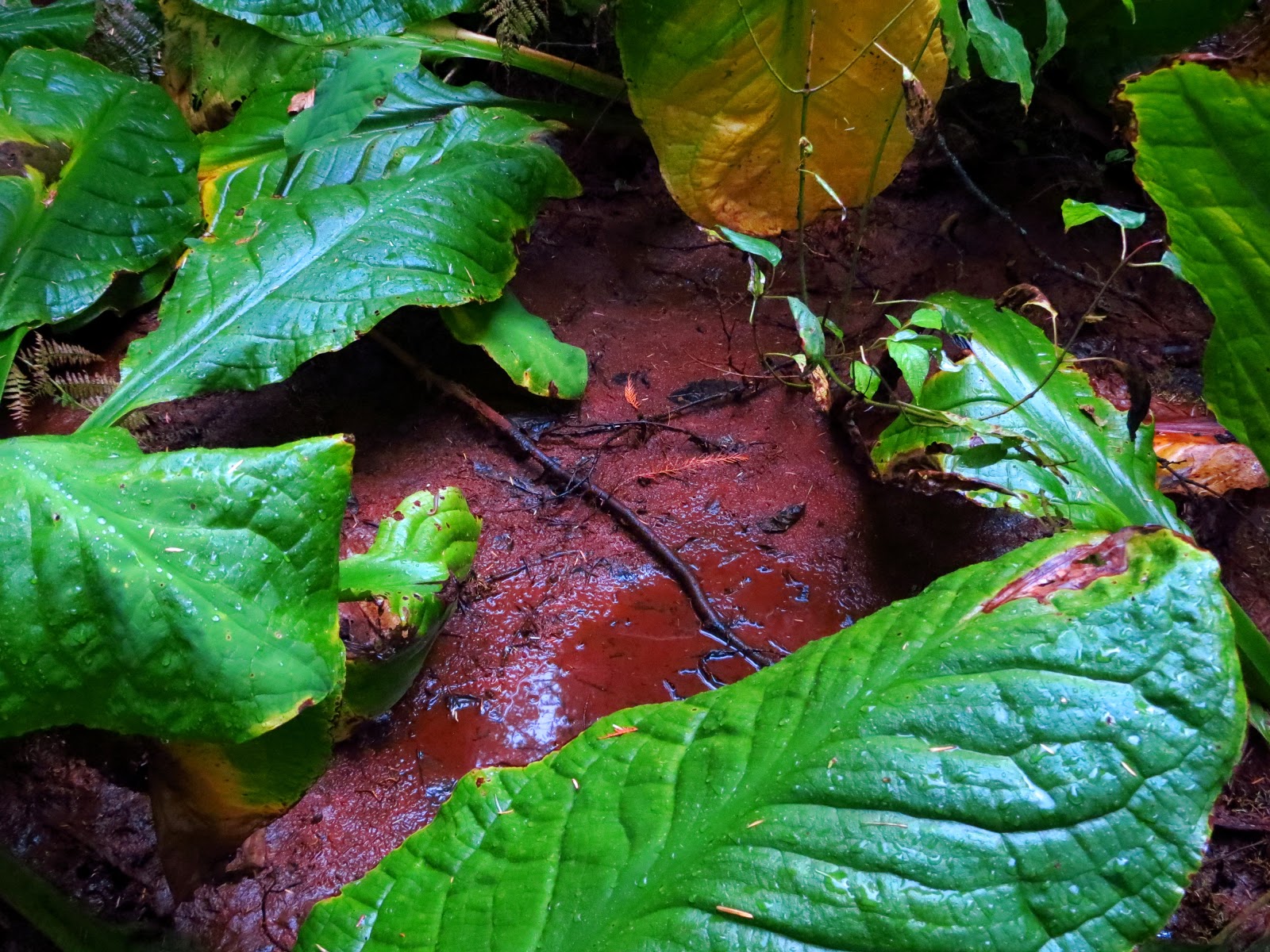
Skunk cabbage grows near the red ochre.

Red pools of water.

tulmnetkʷ is a word I have never seen or heard, but Salish languages allow for the creation of new words based on many possible suffixes and prefixes that can be added to a root. In this case, I used tulmn (red ochre) as the base, and added the suffix -etkʷ, meaning water. Based on this combination, tulmnetkʷ would mean 'red ochre water.'
Saturday, September 06, 2014
Bad Fog

Years ago, Martin Louie took my father as a son. As a result, we usually called him Grandpa Martin, but sometimes we affectionately called him “The Old Man across the River.” Martin was an elder and spiritual leader who lived at Inchelium, near the western shore of the Columbia River. He was a colorful character, often remembered for his wisdom and humor.
From
time to time, Grandpa Martin shared the most profound sayings. Recently, I
found a partial transcript of his stories. The following paragraph contains an
excerpt. He said:
inxaʔcin,
isx̌ax̌paʔ, inqaqnaʔ, istəmtima, ink'ík'waʔ, kʷu c'q'misəlx,
kʷu nc'q'mnitkʷsəlx iʔ k̓əl saʔtitkʷ, məł kʷu cusəlx, ‘lut aksk'əłʔitxm i təmxʷulaʔxʷ.
k'əłʔitxməntxʷ iʔ tmxʷulaʔxʷ, məł yaʕyaʕt way' suxʷxʷ iʔ skəkʕakaʔ iʔ kəl wist.
yaʕyaʔt way nłxʷtl'ilx, mi kʷ xʷt'i…lx, məł iʔ skəkʔakaʔ wikənts t'i
kʷ xʷʔu…l ixiʔ t astk'síc'aʔ.’
In
English:
My
ancestors, my paternal grandfather and grandmother, my maternal grandfather and
grandmother, they threw me out of bed, they threw me into the river, and they
said to me, ‘Don’t sleep while the world goes by. If you sleep while the world
goes by, all the birds will leave and go to the mountains. They will be gone
into the bushes before you wake up, and the birds will see you as a bad fog
surrounding your body.’
This
was a story I had never heard before. In particular, the words ‘bad fog’ caught
my eye as an enigmatic or mysterious phrase. I wondered about the meaning, so I
decided to ask sʕamtic'aʔ – one of our fluent speakers of the Okanagan
language.
She
said, “xʷʔul is like steam that might come up from a boiling pot, but it’s also
like what people say nowadays when they talk about an aura – it’s your energy.”
In that exact moment, a two-year old boy bounded into the room and pounded a drum with a stick. sʕamtic'aʔ pointed to
him and said, “x̌ast i sxʷʔuls. His power is good.”
*
*
Notes:
The Salish text from: i‿ƛ'ax̌əx̌ƛ'x̌aptət i‿scm'iʔm'ay's.
The photograph from: The Grand Coulee: Savior For Whites, Disaster For Indians by Blaine Harden (http://aliciapatterson.org/stories/grand-coulee-savior-whites-disaster-indians).
The Salish text in this post is not 100% correct. The blog font prevents an accurate writing of the font. For a correct version, click here.
Wednesday, July 09, 2014
Ashnola

Part of the time, I got to stay at the language house on the Ashnola Indian Reserve of the Lower Smilkameen. It's kind of a lonesome place - quiet and deserted - but that's part of its appeal. Without the distractions of the city, the place seems to come alive with the gentle blowing of wind through the sage brush - beautiful in a haunting kind of way.


I loved the rattlesnake sign written in the language.
snpinktn

Snpinktn is an indigenous place name in present-day British Columbia that was Anglicized and changed into Penticton. This week I had the opportunity to visit snpinktn with a fluent elder from that area. I was the taxi-man who brought him home from the Sisyikst gathering last week in Inchelium. The whole time we were together, he corrected me when I pronounced the English place name. It might be something casual like, "I've never been to Penticton before," but he stopped me every time and repeated the name in Salish. He spoke the word slowly and emphatically, "Sn-pink-tn." He never uttered a tone of anger or irritation, but perhaps a quiet insistence to not validate the colonial distortion of the indigenous landscape.
This elder's influence impacted me in unexpected ways. I found myself speaking scattered phrases of his dialect, simply because they were present in every conversation - I didn't have to think about it. By the time I left Canada, I found myself thanking cashiers or greeting waitresses in Salish. At the border, the agent asked, "Where did you visit in Canada?"
Without thinking, I said, "snpinktn," and for a moment, I totally blanked on the English name.

The reserve sits on a hillside overlooking the city. Most of the road signs are written in Salish first, followed by English. These are small cultural reminders, but they are so important. I wish our community would do this.

The Outma Sqilxʷ Cultural School helped sponsor an elder's gathering for elders and young people to come together and share cultural knowledge. After taking my friend home, I stayed another couple days to witness some of the cultural events.

My new sl'axt Koy showed some of the
young men how to raise a tepee.


A woman demonstrated a dip net
made entirely from spec'n (dogbane).


She also demonstrated spec'n bags.

Cottonwood canoes on display.


The food for the elder's dinner was cooked in
pit ovens, just like we do at Wellpinit.


Hide tanning demonstration.
Saturday, July 05, 2014
Sisyikst

Elders and community members recently gathered on the Colville Indian Reservation for Sisyikst, a cultural event where traditional craftspeople and artists imparted their knowledge to anyone who wanted to learn. Local experts offered classes in hide tanning, obsidian arrowheads, cedar baskets, beadwork, baby boards, and much more.
As the event unfolded, I was fortunate to attend most of the days, though the hardest part was choosing the sessions. I wanted to do them all. In the picture above, I was learning to make arrowheads from obsidian. The shape was beginning to form perfectly, but right after this picture, the arrow broke in half - all part of the learning process.

The original event poster gives a more complete picture of who attended and what skills they offered to their learners.

One elder from Canada taught us how to make twine bags.

I learned to make beaded earrings.

Inchelium was my home for the week.

On the last day of the event, a group of teachers and learners went up into the mountains to gather cedar roots for basket making.

The cedars are quite majestic.

Last year, I took a basket-making workshop, but I forgot some of the basic processes. I was thankful for the reminder.

Another reminder of the process.

Shelly splitting cedar roots.

During the week, we shared meals in a variety of locations in the community, including the local longhouse. A friend told me that the longhouse was made from a converted bowling alley.

Longhouse door.

The cultural, linguistic, and spiritual skills are equally important. On the Colville Reservation, their dialect of Salish is different than mine. Even so, I was surprised at how quickly it started to make sense.
In the longhouse, this prayer was posted on a bulletin board:
k'ʷl'ncutn,
kʷu p'ixʷłt ikłxʷił,
mi wikn ikscxʷuy,
kʷu kʷul'łt i spuʔus apna tsxlxʕalt,
mi xast iks cxʷuy,
kʷu xʷic'xtt ikspəxpaxt,
mi lut iksnłiptm,
kʷu xʷic'xt t iksk'ʷəck'ʷact.
mi niʕ'ip ctxt'mist.
iʔ tl yayʕat iʔ tl k'ast.
xast t'iʔ c'x̌ił.
Creator,
Light the way for me,
so I can see where I'm going.
Today, make my heart,
So my conduct is good.
Give me wisdom
So I don't forget.
Give me strength
So I can always protect myself
From all evil.
So be it.

Barnaby Island on the Columbia River.

The Columbia River is a massive cultural
and spiritual presence in the region.

When we weren't learning new skills,
we went upriver and picked service berries.


The service berries were especially abundant this year.

Bird nest in the service berries.

At the end the week, I was driving home and found this eagle feather on the highway. It was a perfect ending to a beautiful experience.
Subscribe to:
Posts (Atom)
LinkWithin
