Friday, July 23, 2010

Felts Field


This last Father's Day, my wife presented me with an extraordinary gift. She made arrangements for Mr. Schultz, our friend from CYT, to take me on a two-hour plane ride from Felts Field. This morning I got to collect my gift and experience the skies above Spokane.


Mr. Schultz owns a share of this plane.


Leaving Felts Field, we flew north toward Wellpinit. I always wanted to see the reservation from the air, so we circled a few times.


Flying low over Wellpinit, we saw the trading post, the post office, the clinic, the middle school, and the Health and Human Services building.


Another view of Wellpinit.


We continued north toward Colville, passing Fruitland and Inchelium. In this photograph, the Gifford Ferry crosses the Columbia River.


On the return trip, we saw the new freeway interchange being built on Newport Highway.


Just before landing, we got a clear view of Felts Field with downtown Spokane in the background.

Pioneer


Dakota went on the Pioneer Trek with the local LDS Church and pulled a handcart for several days. By doing this, he paid respect to his ancestors among the Mormon pioneers. In fact, through his mom, Dakota is a direct descendant of James Holt, who joined the LDS Church during the Nauvoo era, served a mission to the Southern States, crossed the plains to the Salt Lake Basin, and eventually settled in southern Utah.

Sunday, July 18, 2010

All Nations


My visit to All Nations Christian Center happened in a round about sort of way.

A co-worker asked me to help her find a new church, and specifically requested a Pentecostal congregation where they encourage speaking in tongues. I'm still not entirely sure why she thought I would know, but I accepted the challenge. Of course, I looked online, but it's really hard to evaluate the character of a church by reading a computer screen.

Then by chance, I happened to meet an old friend who attends All Nations Christian Center. When I told her the two criteria (Pentecostal and speaking in tongues), she said her church would definitely fit that description. I told my co-worker and we set a time to visit.

This morning we attended the 11:00 service. All Nations Christian Center lives up to its Pentecostal recommendation. The pastor preached an impassioned sermon while the congregation members waved their arms and shouted praise to the Lord. It's been many years since I attended a church service like this, but I have to say that I enjoyed my experience. It's nice to visit people who feel so enthusiastic about their religion. I'm also glad to say that my co-worker enjoyed her experience. She plans to attend again next Sunday.

Twin Eagles


Twin Eagles invited me to speak to a group of kids during their summer camp. It was a simple event for singing and telling stories.

Tuesday, July 13, 2010

Belated


A belated post on my family's observance of the 4th...

We visited our friends John and Michaeline to celebrate the 4th of July. They live in Stevens County where fireworks are still legal. Personally, I have not lit fireworks since some time during the late 1980s. It's kind of a fun memory that my children now share. But of course, twenty kids running around with sparklers makes me think seriously about why they became illegal in the first place. Crazy....

In any case, the pictures are kind of fun.


The kids with giant sparklers.


Whitney with a red sparkler.


The smoke-filled yard had an eerie, surreal effect.


Something about this picture reminds me of "Close Encounters of the Third Kind."


John lit "fountains" on an old table in the yard.

Sunday, July 11, 2010

Spokane River History Tour


Four or five years ago, my friend Deb Abrahamson asked if I would represent her during official state or local meetings, in the case that she could not appear herself. I agreed, but she never called on me again, until yesterday.

Deb was scheduled to speak during the Spokane River History Tour, sponsored by the local Sierra Club and the Center for Environmental Law and Policy (CELP). A personal matter prevented her from making the presentation, so she asked me to appear in her stead. With less than an hour notice, I got myself ready and gave an impromptu speech to a group of about twenty five people. As much as possible, I tried to remain faithful to her topic and address the relationship of the Spokane Tribe to our rivers.

A variety of local experts addressed other aspects of the river's history, including Jack Nisbet, Bill Youngs, and Rachael Paschal Osborn.

In the photograph above, Larry Cebula (left) introduces Bill Youngs (right). (Larry Cebula is the author of "Plateau Indians and the Quest for Spiritual Power, 1700-1850.")


Local historian and author Jack Nisbet also addressed the group. I recently had the opportunity to meet Jack when he dug brown camas near Spangle, WA with a student group from Wellpinit Middle School.


Bill Youngs is a local historian and history professor at Eastern Washington University. During the Spokane River History Tour, he addressed two main topics. First he spoke about the founding of the city of Spokane by James Glover. Second, he spoke of the 1974 World's Fair that transformed the heart of the city.

A portion of Bill Youngs' comments bear repeating. He wrote:

During the spring of 1873... James Glover - the founder of Spokane - was traveling through the Inland Northwest looking for a place to establish a town and make a fortune.

After journeying from Lewiston by horseback for several days through the lightly settled Inland Northwest he came to Spokane Falls. Glover knew at once that this was the place to build a town. He knew that a waterfall was the ideal source of power to grind grain and mill timber.

Glover also recognized that the falls were a thing of beauty. Later in life he remembered sitting beside the river on a rock during his first morning in Spokane. "I was enchanted," he wrote, "- overwhelmed - with the beauty and grandeur of everything I saw. It lay just as nature had made it, with nothing to mar its virgin glory."

A century later, stumbling upon the falls, he might have "held that thought" and proposed that the falls be set aside as a National Park. (One of the early visitors to Yellowstone, by the way, thought that Spokane Falls and its environs were even more beautiful than the nation's first national park.)

But James Glover grew up in the age of robber barons, industrial tycoons, and city-builders. Setting aside his realization of the beauty of the falls, he saw dollar signs rather than natural beauty, and said of the setting, "I determined that I would possess it."
I've taken this quote from a website promoting the restoration of Spokane Falls, but these words are almost identical to the ones Bill Youngs told us as we overlooked the Spokane River. Personally, I had never heard this story before. Many times I have myself sat captivated by the beauty of Spokane Falls, and I can hardly conceive that anyone could think to possess such a magnificent, living thing. James Glover not only came to possess the falls, but nearly destroyed them beneath the urban development he instigated.

Thankfully, Bill Youngs did not conclude the story with only an account of Glover's personal ambition or tales of environmental destruction. He also recounted the story of urban renewal brought about by the World's Fair (Expo '74).

Youngs wrote the book "The Fair and the Falls: Spokane's Expo '74 : Transforming an American Environment." The book recounts the history of the river and the fair. Up to that point, Spokane was the smallest city to ever host a world's fair, and arguably, Spokane's fair created a more lasting benefit to the local community than other fairs.

The site of the fair was once a scene of urban decay. The river was completely choked by concrete and steel, railroad trestles and industrial buildings. The city of Spokane used the fair as an opportunity to restore the heart of the river. The old buildings were demolished and replaced with a beautiful 100 acre park: Riverfront Park.

As an aside, I was only three years old during Expo '74, but I still remember opening day of the fair. I remember looking up into the sky and seeing millions of helium balloons mingled with hot air balloons.


The events of the day were filmed by a man named Easy; a video will eventually be released on Community-Minded Television. Easy and I first met last year when I gave a local history presentation at Drumheller Springs.
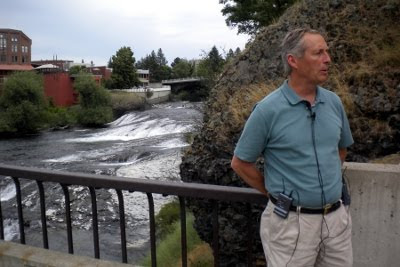


Speed Fitzhugh represented Avista during the tour. He spoke about a recent policy change that will allow water to flow over the falls twenty four hours a day, seven days a week. Previously, Spokane Falls would run completely dry during the summer months as all the water was diverted for electric power.


The Sierra Club was instrumental in negotiating an agreement with Avista to allow Spokane Falls to flow during the summer. Rachael Paschal Osborn addressed the group during the history tour and spoke of the Sierra Club's efforts.


The group concluded the Spokane River History Tour near the site of the World's Fair. The former American Pavilion is visible in the background (left), as well as the old Clock Tower and the Imax Theater.

Dolls


Sometimes my blog includes photographs and stories related to my children, but it rarely contains anything taken directly from their view of the world. Today is an exception.

This morning I found a delightful surprise on my digital camera. As I downloaded my usual pictures, I discovered a series of twenty five photographs and three videos that I did not take. Every image displayed my daughters' dolls arranged in different poses and backgrounds. Of course, it was not difficult to divine who created these interesting little scenes. About half the images featured McKenna's pig dolls and the other half featured Whitney's "ugly" dolls. The image properties indicate that my daughters staged their play-photo shoot on July 3.

I've been smiling to myself ever since I found my daughters' dolls on my camera. They're growing up fast, but I'm happy to see they still enjoy a few childhood moments from time to time.

Thursday, July 01, 2010

Blessing


When His Holiness Katok Getse Rinpoche visited Mount Spokane, he blessed us in many ways. He offered his prayers and teachings, but he also blessed Dakota's drum. Before he even greeted me, he took the drum from my hand, played a few beats, and smiled. He didn't pronounce any words that I recall, but his presence blessed the drum nonetheless.

I feel the same about my father's drums. All the times my father sang at his drum, he left behind a blessing of peace and love. I hope my children learn to cherish these blessings.

Wednesday, June 30, 2010

Merritt Nichols


I recently made contact with Gerrie Asleson, a distant cousin from the Nichols family, and received a photograph of my ancestors Merritt Nichols and Anna Miranda Siloway. Merrit was born in 1817 and died some time around 1900, so this photograph has to be more than 100 years old!

Thanks Gerrie for sharing this piece of our family history.

Sunday, June 27, 2010

World Peace


On Saturday, His Holiness Katok Getse Rinpoche performed a prayer for world peace on the summit of Mount Spokane. As part of the observance, I spoke briefly about the history of the Spokane Tribe. Those who attended the event were very moved. For my part, I felt honored to participate.


During the ceremony, I had the honor to sit with His Holiness and Lama Lakshey Zangpo Rinpoche.


His Holiness and I sat together after the ritual. He spoke to me through an interpreter and asked me questions about the spirits of our ancestral tradition.


The translator Tenzin Weigyal, His Holiness Katok Getse Rinpoche, and Lama Lakshey Zangpo Rinpoche.


Open


For two days and nights we kept a fire burning on the ovens. Then after fifty one hours, we finally opened the pits.


The food turned out beautifully.


Whitney continued to help with the process.

Dawn


The morning after the thunderstorm, a beautiful morning dawned.

Thunderstorm


After the first night of cooking, a thunderstorm rolled across the Wellpinit meadow and nearly washed us away. Pretty much everyone disappeared for dry ground, but Whitney stayed behind to help us cover the ovens with a tarp.


As much as it rained, I'm glad to say the ovens stayed warm and dry.

Earth Oven


After cleaning the roots and gathering moss, we prepared the food for cooking.


Francis built the fire for the oven.


The rocks were heated to red-hot temperature.


The moss was washed.


The food was placed into cloth bags and packed between layers of wet vegetation.


The oven is buried and cooking.

Moss


Before we dug the pit for our camas, we made a visit to the woods to gather black moss. We used a long pole to retrieve the moss from the trees. Black moss, which is actually a lichen, is a traditional food.

LinkWithin

Related Posts with Thumbnails