Wednesday, January 11, 2012

The MAC


This morning I paid a visit to the Northwest Museum of Arts and Culture (the MAC) to lead a student group from an ESL class (English as a Second Language). The students represent a variety of cultures, but the majority have come to the United States from the Himalayan nation of Bhutan.

The Bhutanese students surprised me because of their deep interest in the various exhibits. For example, as we observed several large baskets, one middle-aged woman became somewhat emotional as she explained that many years ago, her father had made a similar basket. Almost every time I have spoken to the Bhutanese students, they remark how similar their culture is to the indigenous people of North America.   


Every item displayed a deep sense of beauty. Every basket, mocassin, or beaded bag reminded me of friends and loved ones who continue to make such things, and while I certainly understand the desire to preserve them, it was difficult for me to see them as simple artifacts. Yes, I appreciate the beauty, but at the same time, I feel sad to know that these items will never be used again.

In the old way, I have heard it said that certain objects sometimes come alive, like a spirit. I wonder then, how these ones feel living always behind a layer of glass.


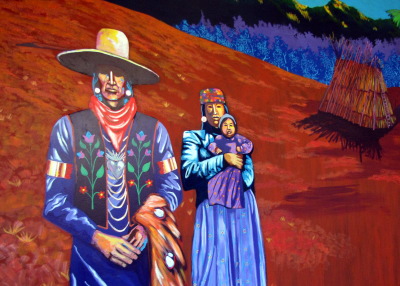
The lobby features a large mural painted by local artist Ric Gendron. I have to say that I have always loved his work. In my experience, his paintings reflect the soul of Indian people in this region. They evoke something deeply inspired and authentic, and they reflect tradition, while accepting the complexities of culture and history.

Sunday, January 08, 2012

etwan


Eighteen years ago today, my father left this world. He would have been 64. Since these anniversaries never seem to leave my heart, I must still have some need to observe his memory and his vision for the world. During the last ten years of his life, he worked hard to promote the traditional ways of our ancestors. He traveled all around the Pacific Northwest and learned from elders in several different Indian communities. He cooked for traditional gatherings and revived many of the old songs.

If he were alive today, I have no doubt that he would be very happy to witness our efforts to re-vitalize the Spokane language.

*

Just the other day, I was thinking about how Native languages are lost over time. Many of our elders once believed that the Indian ways were a thing of the past, so they taught their children to speak only English. In my family, my father was the first generation to learn English as his first language, meaning that I am only the second generation removed from the world of my Salish-speaking ancestors. His parents and grandparents certainly knew English as a matter of convenience or perhaps necessity, but they spoke Salish first. When I consider the 10,000 year span of history in this region, two generations do not seem like a long time.

English was also my first language, but a remnant of the old language persisted.

A scattering of Salish words punctuate the memory of my childhood. For example, some of my earliest memories revolve around asking my father for permission to do one thing or another, and he would often respond by saying, "xʷuyš!" which means, "Go!"

Other times, we followed a strange ritual around driving the car. Where ever we went, my father always sat behind the wheel, but whoever sat in the front passenger seat had the solemn responsibility to watch for cars on the right side of the vehicle. If we came to an intersection, my father would never look to the right. He only looked to the left, which I suppose he regarded as his special domain. With complete trust in the navigator, he always asked, "How is it?" The navigator would then look to the right and decide if it was safe for the car to enter the intersection. If other cars were approaching, the passenger would say, "Wait," but if the road was clear, he would say, "miš," (This means literally: "It is empty.") Upon hearing that word, my father drove forward onto the highway without pausing or making a second thought. In a way, our safety depended on that one word.

From my childhood, I also remember that my elders sometimes asked, "stem' a spuʔus," which was a way of asking, "How are you?" But it literally means, "What's on your heart?" Other words also survived, like yaya (grandmother), sileʔ (grandfather), suyepi (whiteman), or lemlmtš (thank you), but I have no idea why some persisted into our English-speaking world and why others went dormant. 

A while ago, I was also wondering which of all the Salish words was the first to enter my permanent memory. I reflected on this question for several days, and I finally concluded that the earliest word from my childhood is actually my father's name: etwan. A long time ago, our Salish-speaking elders once created Indianized versions of English names - names like misel for Michael, tapit for David, malian for Mary Anne, and etwan for Edward. Some families continue this practice today.

I have virtually no clear memories of my yaya Minnie (my father's mother), but I can still see her in my mind sitting in a chair with a blanket wrapped around her shoulders. I don't remember anything else, except that she called for my father, "etwan, I'm cold. Put some wood in the fire."

*

On this day, eighteen years after my father's passing, I am somehow comforted to know that his name was the first word I can remember learning in Salish. Like a seed left over from a previous generation, that name is a source of power and the beginning of possibilities yet to come.

*

(Salish has no capitalization, so these names are written with all lower case letters).

Saturday, January 07, 2012

Whitney's Audition


Whitney also auditioned for CYT Spokane's Oklahoma and did a wonderful job.

Dakota's Audition


Dakota auditioned for CYT Spokane's upcoming production of Oklahoma. He just gets better and better. I am very proud.

Endangered Cultures


A brilliant TED video recommended by my friend Maggie Dale shows the wonder of cultural diversity within the 'ethnosphere,' especially among indigenous cultures. This video highlights what is lost when the forces of industrialzation overwhelm native peoples; language, culture, and a unique understanding of reality.

Thanks Maggie!

Sunday, January 01, 2012

The New Year


My elder once told me that the old time Indians looked at the new year like a spirit, and as each new year arrived, they always asked him to bring good things and to not leave the people in a pitifual way. This is my prayer for the new year. I didn't make any grand resolutions beyond my desire to recognize the blessings of being alive with my family and friends.

Encore


My family participated in CYT's yearly Encore Encore performance at the Bing Crosby Theater. The kids got to perform select encore numbers from Music Man and Annie, and I got to be King of New York just one more time. After the show, we took a few family photographs on the stage of the theater.


We're looking forward to the upcoming shows of the New Year.

Family


My sister bought a house last year, so this Christmas the family gathered for dinner in her home. We made Italian food, played games, and took the first family photo in several years. What a wonderful time!

Click on the photograph to enlarge.

Monsters


Christmas and the New Year have already passed, and we take one last breath before diving back into the hectic world of work. But this Christmas season was hectic in its own way, with all the shopping, running around, visiting, and in my case, making home-made gifts.

In particular, my daughter loves Ugly Dolls. I have only ever been able to find them at Boo Radley's in downtown Spokane, along with a hundred other bizarre little items. This year, I decided to make my own monster doll. I suppose it means more when it comes from your own heart and hands.

As expected, my daughter loved this doll more than all the others.


The pattern was my own creation.


The doll was named Skalula, after a Native American monster song from the Okanogan country.

Sunday, December 11, 2011

Wild Food


My friend Matthew completed a rather unusual and creative project by eating only wild foods for an entire month. The challenge initially began as a way to save money on store bought food, but it expanded into a school project. He described some of his experiences on a personal blog:


A small group of supporters gathered to celebrate the conclusion of his wild food challenge. For my part, I personally support his project because of my interest in native foods and because I wish to encourage people to become more aware of their natural environment. The more we learn about the living things growing on our lands, the more we feel inclined to protect those lands.


Our menu for the evening included wild turkey, boiled amaranth seeds, venison soup cooked with home grown carrots and beets, and a cobbler made with huckleberries and apples from an abandoned, 'wild' tree, topped with a crust made from cattail flour and ground curly dock.

Choir


After several years of homeschooling, Dakota has returned to the mainstream high school. So far things seem to be going well for him. Participating in the choir has made the transition a little easier.

Monday, November 28, 2011

Completion


Several weeks ago, Dakota finished his eagle project. Some folks were interested in seeing the end result, so I am posting these photographs for their benefit. I have to say that things turned out well. My son has made me very proud.


Friday, November 25, 2011

Thanksgiving


On Thanksgiving morning, I attended an inter-faith service at Temple Beth Shalom where representatives of several faith traditions spoke about faith, gratitude, and peace among diverse peoples. The service was sponsored by the Spokane Interfaith Council, Second Harvest of Spokane, and Temple Beth Shalom.


Rabbi Michael Goldstein led the service.


Before the service, I asked permission to take photographs inside the synagogue. The rabbi gave permission for pictures on any day, except for the Sabbath (Saturday). These prayer shawls were hanging inside the cloak room of the temple.


Sister Mary Euchrista represented the Catholic faith. It was a happy reunion for me because years ago, she completed her student teaching in my classroom at the Medicine Wheel Academy.


Mona Ali represented the Muslim community of Spokane.


Geshe-la also spoke during the ceremony and represented Tibetan Buddhism.


Hebrew writing was displayed in the temple lobby.

Wednesday, November 23, 2011

Mapping the Heritage


My friend and co-worker Carole Parks is helping me to document the heritage plants of Drumheller Springs. Her work will partially fulfill credit for her graduate degree, but will also help prevent further encroachment upon the indigenous plants of the area.

As my readers may recall, I got involved with the preservation of Drumheller Springs after several local environmental groups planted ponderosa pine on the digging grounds once used by the Spokane Tribe. Camas, bitterroot, and other native foods were disturbed by the planting of new trees. This encounter led to a meeting with the Spokane Parks Department and the Spokane Lands Council, and as a result, the Lands Council agreed to remove the trees.

Since that time, I have been working to explore legal and institutional options to protecting the indigenous plants of Drumheller Springs.


When Carole and I visited the land this morning, some of the native plants still had visible parts that she was able to collect for her project.


We also explored some of the other nearby features, including the mural on Ash Street, painted by George Flett and company.


Many plants are still visible, despite the change in weather.

As an aside, I have always been fascinated with these white berries, even though I can't think of any practical uses. I once heard a traditional story that described these berries as the service berries of the land of the dead. Unfortunately, I was never able to locate that story again. In any case, the Spokane Language may corroborate this story to some degree. The Spokane describe these berries as "corpse berries," or tmtmniałq.

If anyone knows of any traditional stories or uses for the plant, please send me an email.

Tuesday, November 22, 2011

We Still Live Here


We Still Live Here - As Nutayunean is a brilliant PBS documentary showing the revitalization of the Wampanoag Language of Massachusetts.

The Wampanoag are perhaps most often remembered as the people who greeted the English Pilgrims at Plymouth and saved them from starvation. In return, the English persecuted the Wampanoag, stole their lands, and actively sought the destruction of Wampanoag culture. Among Indian people in North America, these are the ones who first confronted the loss of language, indigenous identity, and traditional knowledge.

And yet the Wampanoag survived. They continue to live in communities near Cape Cod and Martha's Vineyard.

The documentary begins with Jessie Little Doe, a Wampanoag social worker, who received a dream from her ancestors. They asked if her generation was willing to reclaim the Wampanoag Language. She shared her vision with others in the tribe, and together they began a journey to reclaim their language.

As someone who cares deeply for my own language, this film both inspired and motivated me to continue my efforts to learn and to teach others.

The film is about 55 minutes long and is certainly worth an hour of your time. But you have to watch it right away - the free internet showing of this film ends on November 24. Click the following link to view the film.


A few quotes from the film:

Death is not permanent for languages. They can come back.

We had asked elders and spiritual leaders, “How do we regain our language?” And we were told that it’s not your language that’s lost, it’s you, and that a day will come when a child will be born and they will bring you back the language.

Wednesday, November 09, 2011

Annie


My children are performing at the Bing Crosby Theater in CYT Spokane's musical production of Annie. In the scene above, Whitney plays one of the orphans as she interacts with Miss Hannigan.


This has been an exciting show for Whitney. She has a number of important lines and gets to wear a microphone for the first time.


Whitney with the orphans.


Dakota plays the part of Drake, who is the butler to Daddy Warbucks. In this scene, he is present when Rooster attempts to deceive Warbucks and claim Annie as his own child. In return, Rooster would receive a $50,000 reward. President Roosevelt is also present, seated in his wheel chair.


Drake the butler.


Dakota also uses a puppet on the Iodent radio show, though I was never sure why a person would need a puppet on the radio.


McKenna plays the part of a townsperson in Hooverville.


Another shot of Hooverville.


Mariah also performed in this play.


Small doses of comedy are scattered throughout the play. In this scene, Daddy Warbucks is presented with the original Mona Lisa, but he decides he doesn't like it. "Send it back!" he says.

Tuesday, November 08, 2011

Anthony's Wedding


My foster son Anthony got married in a simple ceremony at the bride's home.

The wedding was a surprise to almost everyone in both families. For my part, I met the bride only once before, and I met her family for the first time just two hours before the young couple took their vows. Even so, Anthony had asked me to perform the ceremony and I agreed.

When the bride appeared and walked down the "aisle," Anthony beamed with happiness and then cried. And when they exchange vows, they both cried. In all the years I have known Anthony, I have only rarely seen him express emotion in this way. The ceremony was simple, but quite beautiful.

I wish Anthony and Nicki all the blessings of the Creator as they build a new life together.

LinkWithin

Related Posts with Thumbnails