Tuesday, April 10, 2012

The Crown


The British Crown holds a strong influence throughout Colonial Williamsburg. When we arrived, we first visited the Governor's Palace. The colonial governors were noblemen appointed by the king to represent His Majesty's interests in Virginia.  


The gate of the Governor's Palace bears the symbol of the king's crown.


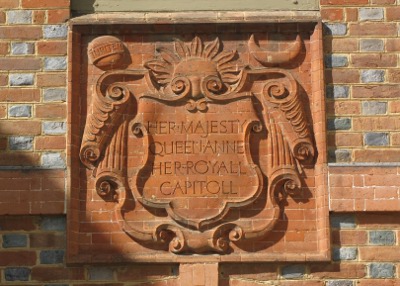
Even the Capitol bear's the inscription, "Her Majesty Queen Anne. Her Royal Capitoll."


A lion adorns a sculpted rendition of the coat of arms belonging to King Geoge III.

It's strange to think that America was once subject to the British Crown, and even stranger to think that we might have remained so today had the king responded to the greivances raised by the colonies.

Edmund Pendleton


Before I left Spokane, Rhonda's mother told me, "When you go to Williamsburg, look for my ancestor Edmund Pendleton." I nodded somewhat absent-mindedly, but I honestly had no expectation of finding one individual within so great an area.


But then I visited the parish church at Colonial Williamsburg, and noticed that each of the box seats surrounding the pews bore the name of the householder who once sat there. To my amazement, the first name I noticed was Edmund Pendleton. The people pictured above are sitting in Edmund Pendleton's box!

Later, I found the pews belonging to George Washington, Thomas Jefferson, and Patrick Henry.


A few moments later, I went back to the pew to get another photograph. As I focused my camera, I stepped backward onto a tombstone embedded into the floor. I looked down toward my feet and was startled to see that I was standing on the grave of my children's ancestor Edmund Pendleton! 

I went outside, plucked a small flower from a nearby tree, and returned to leave it as an offering on the grave.

Monday, April 09, 2012

New York City


A few weeks ago, the college selected two names at random to attend an adult basic education conference in Norfolk, Virginia. My name was pulled out of the hat, along with Pamm's name. We left Spokane early this morning and made connecting flights in Minneapolis and New York City.

I've never visited New York, so I was a little excited to get a few pictures, if only from the airplane.


Tuesday, April 03, 2012

Olsen and Bain


Genealogy often requires extraordinary patience and dedication, especially when a researcher has to sift through hundreds of microfilm images or dozens of musty old books. However, nothing compares to the exhilaration when that one name finally appears on the page or the screen.

And every so often, wonderful information appears when least expected.

Just this evening, I stumbled upon some old photographs of my ancestors Daisy Bain and Odin Olsen. They were my grandmother's grandparents, and before tonight, they were little more than names on a family history chart.

Daisy Bain is photographed above. She was born in Canada to Scottish parents and later married Odin Olsen in Minnesota. Then for reasons I have never been able to discover, she relocated to Salt Lake City after the death of her husband. Several years ago, I found her burial site in a vault in the basement of a mausoleum overlooking the city.

Something about her eyes inspires me, but I can't say why.


Odin Olsen is pictured above. He was born in Wisconsin to Norwegian parents. I know very little about his life, except that he died while away from his family.


Odin's parents were Iver Olsen and Berit Pederson. They immigrated to the United States from Norway.


If I remember correctly, Iver's grandfather was Matthias Dalager. Matthias was originally from Greenland, born to a Danish father and an Inuit mother. In this picture, I almost imagine that I can see the Inuit features in Iver's face.

Tuesday, March 27, 2012

Tree Removal


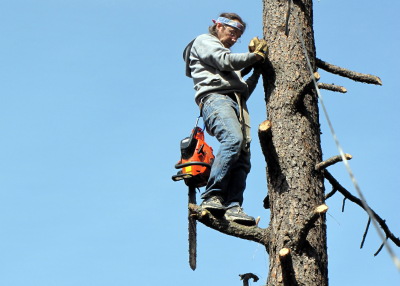
We removed a ponderosa pine from our back yard.

Several months ago, the tree closest to our back window began a slow transformation and turned more brown than all the others. Eventually it died and left behind a tangled mass of withered branches and dried needles.

The dead tree attracted the attention of passing salesmen hoping to reap the benefit of our misfortune. One stopped by unannounced and said, "Your tree is visible from the street. For a thousand dollars, I'll remove it." A thousand dollars? No, thank you! A few days later, another salesman knocked on my door. He quoted me $700 and quickly added that his family was desperate to find work. I would love to help, but even at a substantial discount, almost any amount was too much. This economy has affected us too.


The tree also attracted the attention of a pileated woodpecker with a beautiful red crest on its head. He generally appeared in the mornings and peeled the bark away from the trunk of the tree. In a few short days, the woodpecker managed to strip more than half the tree and leave a pile of discarded bark on the ground. Our family was somewhat entertained by the unusual appearance of this bird, until someone informed me that the woodpecker was eating beetles, the same beetles that killed our tree.


We found ourselves in the dilemma of needing to remove the dead tree but without much money to do so. I finally offered to pay a friend $100 a month for several months if he would cut it down. He refused the offer, but instead showed up to remove the tree at no cost.


My friend climbed the tree and removed the limbs one by one. Meanwhile, I stood on the ground a simply prayed that he wouldn't slip or fall.


After removing the branches, he cut the main trunk into sections. He connected a rope to each section and had me pull them to the ground, thereby directing the direction of their fall. Despite my anxieties, everything landed without a hitch.


Once the tree was on the ground, we found the first concrete signs of the infestation. The inner bark was riddled with the carved channels left by the beetles.


At the very end, we even found a few beetles that managed to escape the woodpecker. Hopefully we stopped the infection of the other trees in our neighborhood.

As a side note, my kids counted 102 rings of the tree stump. It's hard to think this living thing has stood on this place for 102 years.


Sunday, March 25, 2012

Auditions


The CYT tradition continues in my family as the kids auditioned for yet another show: Bye Bye Birdie. The cast list has not been released, but whatever the outcome, I am very proud of their hard work, talent, and dedication.

If you haven't seen their audition videos, you can see Dakota, McKenna, and Whitney by clicking on the links.

Tuesday, March 20, 2012

Confidence


Whitney gave a talk in church last Sunday. Actually, I am quite amazed at the confidence and poise she demonstrates in social situations. I'm not sure that I ever possessed that level of self-assurance, especially not at her age. Without question, her faith and her experience in theater have been the two greatest factors in creating trust in herself.

Sunday, March 18, 2012

Prom


Dakota and Jessica went to this year's prom at Northwest Christian. He's not even a senior, but this is Dakota's second prom.

Our friend Laura came over to help them get ready. She gave Dakota a new haircut and then styled Jessica's hair. While this was happening, Rhonda played all the greatest songs from the 80s while everyone sang along and laughed. It was a wild time, enjoyed by all.

Of course, I got recruited to take a few pictures.

As Dakota and Jessica drove away, I got to thinking how short their childhoods have been. In a few years, our kids will grow up and move away. It's a bitter-sweet thought, for sure.


Wednesday, March 07, 2012

Sweet Child of Mine


This year, I sang "Sweet Child of Mine" by Guns 'n' Roses. The vocal quality was not the best, but I had a great cheering section and ultimately won first prize. You know, I don't think I ever came in first for any contest. In any case, we had a wonderful time. It was a great day!

Salish Conference


The Celebrating Salish Conference is gathering Interior Salish speakers from all over the Inland Northwest for a week of celebration, storytelling, music, and laughter. As always, the conference is renewing my commitment to continue learning the language.


Young actors portrayed traditional stories in the Kalispel Language.


Once again, I sang in the Salish karaoke contest.
A video will be posted shortly.

Tuesday, March 06, 2012

Sundogs


Several days ago - I think it was last Friday - I was driving home from Spokane Community College, when I saw a pair of sundogs or parahelia on either side of the setting sun. Perhaps it's odd to say, but I feel a certain excitement when I witness natural phenomena in the sky. I might even say that I feel a sense of purpose or kinship from the signs above us.

This event got me to thinking, "Is there a Salish name for sundogs?" Sure enough, Father Giorda's Kalispel Dictionary of 1879 says that the Kalispel word for sundogs is: sololágani.

As I have mentioned before, the priests used a different phonetic system than we use today, which sometimes creates ambiguity around the true pronunciation of old words. This is especially true if the words have fallen into disuse. Short of finding someone who might remember, we are left to speculate regarding the true pronunciation and etymology.

In my attempt to discover the pronunciation and underlying meaning of sololágani, I looked for other words in the dictionary that begin with the same prefix "solo." I found only two: sololímalks and sololominch. Both words have reference to iron, and in particular, the second word refers to an iron weapon or a gun of any kind. This gave me a starting place for a possible pronunciation.

In the Spokane Language, a gun is called: sululminč, so if the same pattern holds, sololágani would be written sululáx̣ni.

This creates several possibilities with regard to its meaning or literal translation.

The first possibility might have some relationship to the same root word as iron. It is my impression that iron gets its Salish name from something that burns - hec ulpmi. This would probably have reference to the process of smelting iron. Also, -ax̣n is a suffix that makes reference to the arms. Therefore, the name for sundogs might indicate something with burning arms or a burning fire near the arms of the sun. Very often sundogs do appear as two smaller suns at the sides (or arms) of the true sun.

Other possibilities probably exist, but as of this moment, this explanation is my favorite candidate. But then again, maybe someone will tell me otherwise.

In any case, this leaves me with one final question. What did sundogs mean within our traditional stories? What did they mean within the cultural stories of Europe and elsewhere?

Sunday, February 26, 2012

Ice


A while back, a friend told me that he appreciates my blog posts regarding the Spokane Language and local history, but he said that he misses seeing my photography. Things have been pretty busy, but I do have a few pictures from a few weeks ago that may suffice.

Near the end of January, we experienced a storm that left Stevens County covered in a solid sheet of ice, (I was visiting friends in that part of the world). In fact, the highway was so slick that I spun out and drove into a ditch, and I was only driving five miles per hour! A drive that normally took an hour, lasted more than five.

In the photograph above, the sunset leaves a shimmering reflection over the ice.


A layer of ice formed over everything, including the windows of my car.


But once the clouds and fog cleared away, the sunset was magnificent.


As the sun slipped below the horizon, only a sliver of red light remained.

Sunday, February 12, 2012

Dakota


Dakota sang for Glenda's voice recital yesterday evening. Many thanks to Marsha Schlangen for recording the accompaniment.

McKenna and Whitney


McKenna and Whitney sang for Glenda's voice recital yesterday.

Saturday, February 11, 2012

The Creator


During the late 1800s, Father Joseph Griva translated several Catholic prayers and catechisms into the Kalispel Language. As I have mentioned before, I appreciate these translations because they provide examples of complex sentence structure in Salish. These books have greatly deepened my understanding of the language.

In this example, Father Griva wrote:

Kuemt lu gol shei lu kolinzuten z-koltz lu skusees lu tel sch-chemaskat ks chinshitems lu skeligu ie l stoligu. Lu skusees kolinzuten shei lu Jesu kri. Jesus shei unegu kolinzuten. Jesus shei negu skeligu. Jesus potu it shei kolinzuten u skeligu.

The same text in the IPA format:

kÊ·en't Å‚uÊ” x̣Ê·l šey' Å‚uÊ” k'Ê·ul'ncutn ckÊ·ulsc Å‚uÊ” sqÊ·seÊ”s Å‚uÊ” tl' sččmasq't qs čnšitms Å‚uÊ” sqelixÊ· y'e l' stulixÊ·. Å‚uÊ” sqÊ·seÊ”s k'Ê·ul'ncutn šey' Å‚uÊ” yesukli. yesu šey' unexÊ· k'Ê·ul'ncutn. yesu šey' nexÊ· sqelixÊ·. yesu puti t šey' k'Ê·ul'ncutn u sqelixÊ·.

My translation back into English:

Then for that (reason), the Creator sent his son to us from the sky to help the Indians (people) here on the earth. The Creator's son is indeed Jesus Christ. Jesus is truly the Creator. Jesus is also Indian (human). Jesus is still (continually) Creator and Indian (human). 

*

Translation is never an exact science.

Without question, the priests intended to say that Jesus is human; however, in our language, the word for human (sqelixÊ·) is also the word we reserve specifically for ourselves as Indian people. In fact, after white people began arriving in great numbers, a division in the language occurred. Our ancestors retained the original human designation for Indian people (sqelixÊ·) and assigned a different term for white people (suyepi). Nowadays, sqelixÊ· and Indian are nearly synonymous.

Perhaps ironically, the priests declared in their own catechism that Jesus is Indian. This makes me wonder how our elders would have perceived this teaching. In my imagination, I picture them smiling and nodding in agreement, but in the back of their minds, they may have said to themselves, "Of course the Creator is Indian. We knew that all along."

And if the Creator is Indian, then we will relate to him as we always have, with our own ceremonies, prayers, and songs.

Thursday, February 09, 2012

łu tel kaimintis kolinzuten


More than 100 years ago, the Jesuit missionaries brought Christianity to the Salish-speaking peoples of the Inland Northwest, and as I've mentioned before, the main branch of my family adopted Catholicism as far back as the 1840s. It's a complex and confusing history. On the one hand, the early Jesuit fathers mastered the Salish languages to an amazing degree of fluency. They even published books in the language! But a generation later, Catholic schools were punishing Indian children for speaking anything other than English. What a bizarre irony of history! They meticulously documented the language, only to later encourage its eradication.

The contradiction is unfathomable, but at the end of the day, I really am grateful that the priests wrote about their experience of the Salish language. More than a century later, their writings have both supported and deepened my own learning process.

In 1879, the Missionaries of the Society of Jesus published a compilation of Bible stories written in the Kalispel Language: Å‚u tel kaimintis kolinzuten (From the Writings of the Creator). To my knowledge, they never attempted a complete translation of the Bible into any interior Salish language, but kaimintis kolinzuten is perhaps the most complete Biblical text ever written in a local dialect. It includes all the major stories of the Old Testament, along with a thorough summary of the four Gospels.

Of course, the priests did not have the benefit of our current writing system, sometimes known as the American Phonetic Alphabet or the International Phonetic Alphabet. They invented their own system of writing based upon a simplified version of the Roman letters. Their writing was difficult for me to understand at first, but once I learned a few basic substitutions, I found that it was relatively easy to decipher.

For example, the priests used the letter 'g' to indicate most of the 'x' or 'xÊ·' sounds. They also used the letter 'z' to represent the 'c' or the glottalized 'c'.

The following is a sample of the text, followed by a transcription in the current writing system and a tentative translation into English:

T-KOLINZUTEN kólis Å‚u s'chchmáskat, u Å‚u stóligu. U Å‚u stóligu i choólegu ... Å‚u lesshii̓ti sgalgált, zúti: Kskol'li Å‚u spaáka, u kolil Å‚u spaáka ...

t k'Ê·ul'ncutn k'Ê·ul'is Å‚uÊ” sččmasq't, u Å‚uÊ” stulixÊ·. u Å‚uÊ” stulixÊ· i č'uw'leÊ”xÊ· ... Å‚uÊ” l' hecšÊ”iti sx̣lx̣alt, cuti: qs k'Ê·ul'l'i Å‚uÊ” sp̓aÊ”aq, u k'Ê·ul'l' Å‚uÊ” sp'aÊ”aq ...

The Creator made the sky and the earth. And the earth was a deserted place ... On the first day he said: Let the light be born (made), and the light was born (made) ...

Of course, it is important to note that a person could not really learn to speak the language using only the Jesuit text. The letters are relatively consistent, but the sounds are not precise. Having said that, the text provides a valuable resource to anyone who already has a solid understanding of the modern writing system. With a few substitutions, I have been able to read and understand the writing and thereby answer a few long-held questions about grammar and sentence structure. And since the Spokane Language is so similar to the Kalispel, these books provide crucial insights into my own understanding of Salish.

Saturday, February 04, 2012

Broadway Night


Dakota sang an amazing rendition of They Live In You (from the Lion King) at Mead High School's Broadway Night. It was a brilliant, inspirational performance - with goose bumps and all. As always, my son makes me proud.

Thursday, January 19, 2012

Snow


ho....y čicntm Å‚uÊ” sÊ”istč y'e n sÆ›x̣etkÊ·. xÊ·eÊ”it hec mox̣Ê·pmi y'etÅ‚x̣Ê·a, u xÊ·eÊ”it Å‚uÊ” sm'ek'Ê·t y'e n stulixÊ·. yoyot čn lemt x̣Ê·l n̓e sqepc, m qe tixÊ· t sewÅ‚kÊ· x̣Ê·l qe sqelixÊ· sÊ”iÅ‚n... Å‚uÊ” sp'eÆ›m, Å‚uÊ” p'ux̣Ê·p'ux̣Ê·, Å‚uÊ” st'šaÅ‚q... hecya stem'.

kÊ·en y'e sč'Å‚q'Ê”incut č' čsax̣m Å‚uÊ” ntx̣Ê·etkÊ·.

Tuesday, January 17, 2012

Ancestors


y'e kÊ·iÆ›̓t sč'Å‚q'Ê”incut tl' int'upyeÊ” Leyton Moses, nexÊ· Å‚uÊ” p'x̣Ê·p'x̣Ê·uc. Joseph Moses Å‚uÊ” m'estm's u Ellen Å‚uÊ” tum's. q'Ê”intem Å‚uÊ” skÊ·esc t q'Ê·aylqs Father Connolly, nexÊ· Å‚uÊ” snqlixÊ·skÊ·esc. ec'x̣iÅ‚ q'Ê”intes Å‚uÊ” q'Ê·aylqs: Qui-métqu Å‚uÊ” Leyton snqlixÊ·skÊ·esc. Seésh-shm-ta Å‚uÊ” Ellen snqlixÊ·skÊ·esc. Å‚uÊ” Joseph Moses Æ›̓m epÅ‚ esel  snqlixÊ·skÊ·est (šey' cuti Å‚uÊ” q'Ê·aylqs): Ch-tóh-see u Pah-ko-tés.

ta hec misten lčen u qeqs q'Ê”intem Å‚uÊ” skÊ·esc y'etÅ‚x̣Ê·a.

Another photograph of my great grandmother Leyton Moses, along with her parents. Joseph Moses was her father and Ellen was her mother. Their names were written by the black robe (priest) Father Connolly, and also their Indian names. This is how the priest wrote: Qui-métqu was Leyton's Indian name. Seésh-shm-ta was Ellen' Indian name. Joseph Moses had two Indian names (according to the priest): Ch-tóh-see and Pah-ko-tés.

I do not know how we would write their names now (in the modern Salish alphabet).

Leyton


Å‚uÊ” in t'upyeÊ” Leyton Moses u Å‚uÊ” stmčÊ”elc Nellie Pichette.
My great grandmother Leyton Moses and her daughter Nellie Pichette.

Saturday, January 14, 2012

Mary Walker


Several days ago, I held in my hand a most extraordinary book - an original hand-written Spokane dictionary compiled by Mary Walker sometime between 1838 and 1848. The book was constructed from several folded sheets of paper that were bound together by a simple black thread. The pages contained a random mix of words written in both ink and pencil, along with an assortment of streaks and household stains.

I was actually surprised they allowed me to handle an original document from the 19th century.

This hand-written dictionary resides in the Northwest Room of the Spokane Public Library. Before I was allowed me to view the book, I had to sign a special agreement that included my driver's license number and other identifying information. With all the paperwork complete, the librarian simply handed me a folder that contained the original book.

*

Elkanah and Mary Walker lived among the Spokane people from 1838 to 1848. The American Board of Commissioners of Foreign Missions sponsored the Walkers as missionaries to convert the Spokane to Christianity. After following the Oregon Trail to Walla Walla, they eventually settled in a place called Tshimakain, near present-day Ford, Washington.


The Walkers lived among the Spokane for nine years, but never made a single convert. Their failure to win souls for Christianity perhaps stemmed from their ethnocentric view of religion. The Walkers demanded that the Spokane not only abandon their existing spirituality, but also adopt a European, agrarian lifestyle. How farming became a requirement for salvation, I'll never know. But their diaries also suggest that both Mr. and Mrs. Walker often expressed contempt for Native customs, beliefs, and traditions.

Years ago, I remember reading that Mrs. Walker sometimes scolded the Spokane for what she perceived as sinful behavior - things like practicing Indian medicine or 'stealing' from her garden. Some parts of her dictionary seem to reflect a basic misunderstanding of the culture and a focus on negative behavior. In fact, the initial three words on the cover page are: to steal, to lie, to hide away.

It is easy to see why the mission failed to gain converts.


Despite the apparent ethnocentrism, Mary Walker's dictionary offers some insight into the origins and development of the Spokane Language. For example, the second page contains the Spokane word for the soul: sinhupows. Mrs. Walker created an improvised spelling system, but still the word bears an obvious resemblance to the correct pronunciation: snx̣pew's.

The appearance of this one word inspires an interesting question in my mind. For several years, I have heard the story that the Spokane word for the human soul was a creation of the Catholic missionaries, and yet Mary Walker may have recorded that word as early as 1838, several years before the priests even arrived in the area. My family did not become Catholic until some time between 1842 and 1845. The Protestant and Catholic missions did overlap somewhat, so it is possible that they shared a common vocabulary, but I have to wonder if Calvinist missionaries would accept a Catholic description of the soul.

Another interesting word that she recorded was a word for spirit: Npupowlish's. This word is similar to the word npupewlštn, which has reference to the breath. Once again, this makes me wonder if that was an original Spokane concept of the spirit or a Christian innovation.

*

I cannot say that Mary Walker's Spokane Dictionary added to my vocabulary - her book was really nothing more than a word list - but it inspires me to see a written account of the Spokane Language from almost 175 years ago.

*

The Walkers abandoned the mission shortly after the Whitman Massacre in 1847. Some time later, Mrs. Walker composed a poem to remind her children of their birthplace among the Spokane:

Tshimakain! Oh, how fine, fruits and flowers abounding,
And the breeze, through the trees, life and health conferring.
And the rill, near the hill, with its sparkling water
Lowing herds and prancing steed round it used to gather.
And the Sabbath was so quiet and the log house chapel
Where the Indians used to gather in their robes and blankets.
Now it stands, alas forsaken: no one with the Bible.
Comes to teach the tawny skailu (people) of Kai-ko-len-so-tin (God)
Other spots on earth may be to other hearts as dear;
But not to me; the reason why, it was the place that bore me.
 
*
 
Notes:
 
1. The correct spelling of people is sqelixÊ·.
2. The correct spelling of Creator (God) is k'Ê·ul'ncutn.
3. The poem is quoted from:
 
http://www.historylink.org/index.cfm?DisplayPage=output.cfm&file_id=7204.

LinkWithin

Related Posts with Thumbnails