Sunday, January 05, 2014

Sixty-Six


My father would have celebrated his 66th birthday today, but I wonder how many people still remember. Every year, the seven days surrounding the anniversaries of my father's birth (Jan 5), death (Jan 8), and burial (Jan 12) have become Days of Remembrance - almost religious in their personal significance. This year is especially meaningful because it is also the twentieth anniversary of his passing. 

No matter the time and distance, my sadness always returns to visit during these seven days, like an old, faithful friend. The sadness is not nearly so heavy as before, but it always returns. 

This year my thoughts also turn to my Uncle Richard's family. I've had twenty years to adjust to a world without my father, but my cousins are just beginning that road. Every holiday, birthday, and anniversary will bring a strange mix of sadness, confusion, memory, and love. Nothing makes that path any easier, except perhaps to know that others help carry the weight of grief. 

Early in my own grief process, I would have given anything to banish the darkness and pain from my mind. Sometimes it seemed too much to bear, and certainly many well meaning friends also encouraged me to pick up the pieces and move on, but sadness always returned. I've come to realize that we live in a culture that is immensely uncomfortable with darkness and grief - either in oneself or in others. What is more, I saw myself as a spiritual person dedicated to light and growth, so even I wondered how it was possible for the darkness to cling so persistently to my spirit.   

If they would have given me a pill to cure my sadness, I would have gladly accepted. Actually, at one time, I did take pills with names like Paxil, Wellbutrin, Celexa, and Effexor, but they did nothing to alleviate my distress.

Time doesn't really cure all wounds, but it does make them bearable. Now I have enough distance to view the grief from a different perspective, and this year, I intend to approach this week with a new-found acceptance of both light and darkness. 

My friend Tim recently loaned me the book Owning our own shadow: Understanding the dark side of the psyche by Robert A. Johnson. This book essentially says that the darkness within us never really goes away, but it can get buried. If we don't find ways to honor the shadow, it comes out sideways with difficult and unpredictable results. Johnson (1991) wrote, "To refuse the dark side of one’s nature is to store up or accumulate the darkness; this is later expressed as a black mood, psychosomatic illness, or unconsciously inspired accidents" (p. 26). 

Honoring the shadow seems counter-intuitive. We spend much of our lives trying to banish, avoid, overcome, resist, minimize, or ignore the shadow, yet even Jesus reminded us: "Blessed are they that mourn, for they shall be comforted" (Matthew 5:4). After all my dark nights of grief, the sun has become all the more brilliant and the blooming flowers of spring sing more sweetly than before. Was any of this possible without first passing through darkness?       

Johnson wrote, "To own one's own shadow is to reach a holy place - an inner center - not attainable in any other way. To fail this is to fail one's own sainthood and to miss the purpose of life" (p. 17).  He also said, "I have to honor my shadow, for it is an integral part of me" (p. 22). 

I've heard it said that compassion literally means to "suffer with," so this year will be different. Beginning this week of remembrance, I will honor both sadness and joy because they have given me the greatest gift of all: love.


The dry stalks of stinging nettle. 
The sun setting near the Little Spokane River. 
The sun was reflected in a pool of water. 

These fruits look like rose hips, but the plant does not have any thorns. 

Saturday, December 28, 2013

Frost


The frost formed like a thousand frozen thorns - so beautiful and haunting all at once. It reminded me of the mysteries of living and dying, of beauty and destruction. During the summer, these flowers sang with the wind and laughed for joy, but now they wither beneath the icy grip of death. Through my tears, I pray that the warmth of spring will melt the frost and allow these flowers to return and smile again. 


These photographs were taken at Drumheller Spring. 

Thursday, December 26, 2013

qeqs npiyelsi


A couple nights ago, I heard the rain falling outside my window, and I thought for sure that our white Christmas was doomed to melt. But then we awoke this morning to see the world glittering and white. All the trees, plants, and branches were covered with beautiful, needle-like ice crystals. 

After opening presents this morning, we drove to Wellpinit and enjoyed Christmas dinner with my father's side of the family - the first time in many years.

Just before dinner, my uncle prayed for the food in the Spokane language, and then sang an old Christmas hymn in Salish: 

   qeqs npiyelsi šey' qeqs nkʷnem.
   qeqs npiyelsi šey' qeqs nkʷnem. 
   k'ʷl'ncutn sqʷseʔs, 
   xʷl qʷn'qʷin't łuʔ sqelixʷ. 
   tl nwist cwamist.
   cwełkʷp, xest yesu. 

Roughly translated:

   Let us be happy and let us sing. 
   Let us be happy and let us sing. 
   The Creator's son,
   Because the people were pitiful,
   Came down from up high. 
   Come down, good Jesus.   

He talked about the elders from fifty years ago and before; how they believed in our traditional ways, but they also believed in the church way. With our communities divided, it is difficult to imagine people nowadays walking more than one spiritual path, and yet my uncle holds both realities in his spiritual life. 

His compassion is an inspiration to me. 

As we drove away, I reflected again and again on his prayer. I found myself filled with gratitude, and then to add perfection to inspiration, we witnessed one of the most spectacular sunsets in my life. It was like his prayer for happiness spilled into nature and filled the sky. It was a beautiful day, blessed with family, spirit, and love. 

Following are some pictures of the day (click to see a larger version of each):


The early afternoon sun 
shone beautifully over the 
frozen landscape. 


A farm road near Charles Road.


The plants were frosted white. 


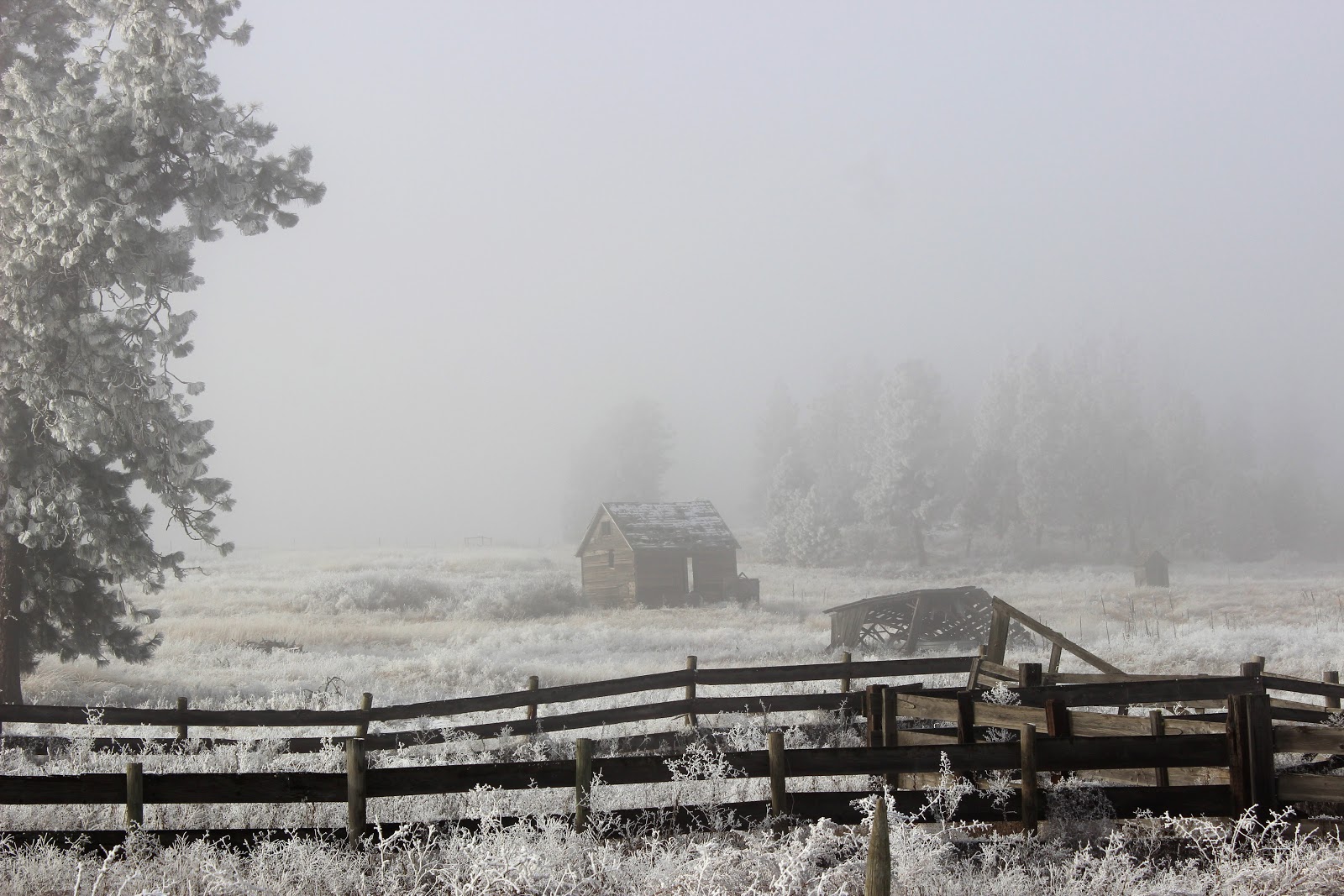
An abandoned house in the fog. 


Even the trees were frosted white. 


The sunset behind frozen tree branches. 


The road below Coyote Spring.


Ice crystals everywhere...


The sun setting over 
the Spokane River valley.


As I was taking pictures, 
the sky erupted into a blaze 
of golden light. 


It was one of those moments 
that took my breath away. 
It almost made me want to cry. 


The abandoned house, 
now bathed in the 
pink light of sunset. 


The last golden band of light
at the end of a beautiful day.

Tuesday, December 24, 2013

pipit nčputetn sxlxalt


The recent winter solstice caused me to reflect on a Salish version of words related to Christmas. Obviously, Christmas was not originally an indigenous concept, but the majority of our people have accepted it, and Christmas is now an inextricable feature of our cultural landscape. 

The Montana Salish dictionary described Christmas as nwel, which would seem to arise from a French influence.

The Spokane Dictionary did not provide a translation for Christmas; however, an old Rawhide Press from the late 1970s advertised Salish Christmas cards with the following inscription: pipit nčputetn sxlxalt (happy most sacred, holy day).

Sunday, December 22, 2013

Winter Solstice


For those of us who live in the northern hemisphere, the winter solstice marks the moment the sun reverses its descent into darkness and begins its return toward spring. From this moment, the days grow longer and the nights shorter. 

Ancient cultures imbued this event with deep significance, including early Christians who aligned the birth of Jesus to coincide with the solstice. Two thousand years ago, the solstice fell on December 25th, so that was the day chosen to observe the birth of God's son as the divine light that returns to the world. 

Indigenous cultures also observed the solstices. Language provides an insight into the cultural practices of our ancestors. 

Chris Parkin recently offered an Okanagan rendition of the winter solstice: sxʔim'łt'ət'q'asq't. This inspired me to find a Spokane version. 

According to Ross (2011), "Both the equinoxes and solstices, the longest and shortest of days, were recognized [by the Spokane] as a type of calendar (snsay'n'ʔasq'tn'), which delineated the four seasons of the year" (p. 737). He also wrote: 

The Spokan divided the year into lunar months, each of which commenced with a full moon and ended with the moon's waning. They also recognized the winter solstice (sk'ʷsus - "hunting drives" or hoy yaʔk'ʷaqs łuʔ sʔanłq) and summer solstice (sʔanłq or hoy yaʔk'ʷaqs łuʔ sʔistč), which commenced on a full moon (pp. 737-738).

These phrases seem to have both descriptive and symbolic meanings. For example, the phrase, "hoy yaʔk'ʷaqs łuʔ sʔanłq" (winter solstice) seems to say, "The summer has crossed the road." They seemed to recognize the opposite season crossing back.

An unpublished Spokane dictionary has a word for the longest day of the year: čʔosšnasq't, but not for the shortest. This is similar to Father Giorda's account when he wrote (1879): Usshinaskat (p. 85), which in modern orthography would be written as usšnasq't

Father Giorda's account of the shortest day was less obvious. He wrote: Chlguuzaskat. In modern writing this might be čłxʷcasq't or čxʷcasq't but I am not positive. Perhaps someone reading this post can say for sure.  

* Note: Elmendorf placed the beginning of seasons at the new moon. 


These photographs were taken 
in my yard on the winter solstice. 


References:

Giorda, J. (1879). A Dictionary of the Kalispel of Flat-Head Indian Language. St. Ignatius, Montana: Missionaries of the Society of Jesus.
Ross, J. A. (2011). The Spokan Indians. Spokane, WA: Michael J. Ross.

Tuesday, December 17, 2013

Rest


Finally, the semester reached its end, and I can breathe for the next few weeks of winter break.

One of the biggest problems of working simultaneously at three colleges is that each term ends at the same time, causing a convergence of pressing responsibilities. At the community college, the end of the quarter always brings a rush of last minute assignments and students trying to graduate after being absent for three months. At Whitworth, grades are always due during this time. And of course, Gonzaga makes me submit my own coursework during that time. Needless to say, that convergence can cause more than a little stress.

But..... it has all ended, and now I can relax a minute.  

This photo is from tonight's sunset. 

Sunday, December 08, 2013

Winter Hike


What an amazing day! My friend invited me to spend the day outside in the beautiful, frigid sun. He said, "Let's go someplace with cultural and historical significance." So then, we went to see the falls on the Spokane River. 


A rainbow over the ice at Spokane Falls. 


Basalt covered in a layer of ice. 


A new sculpture has been installed along the banks of the Spokane River, below the Monroe Street Bridge. It depicts an Indian man on horseback, holding a salmon toward the river. I didn't see the artist's name. 


The horse by the river. 


An offering of salmon by the falls. 


Rainbow...


After visiting the falls, went to see the home site of Slough-Keetcha (Chief Spokane Garry). Of course, I have blogged this site before, but this time, I especially noticed the part of the historical marker that called him a Peacemaker. 


The waterfall in Indian Canyon was frozen, 
and people were climbing the ice. 


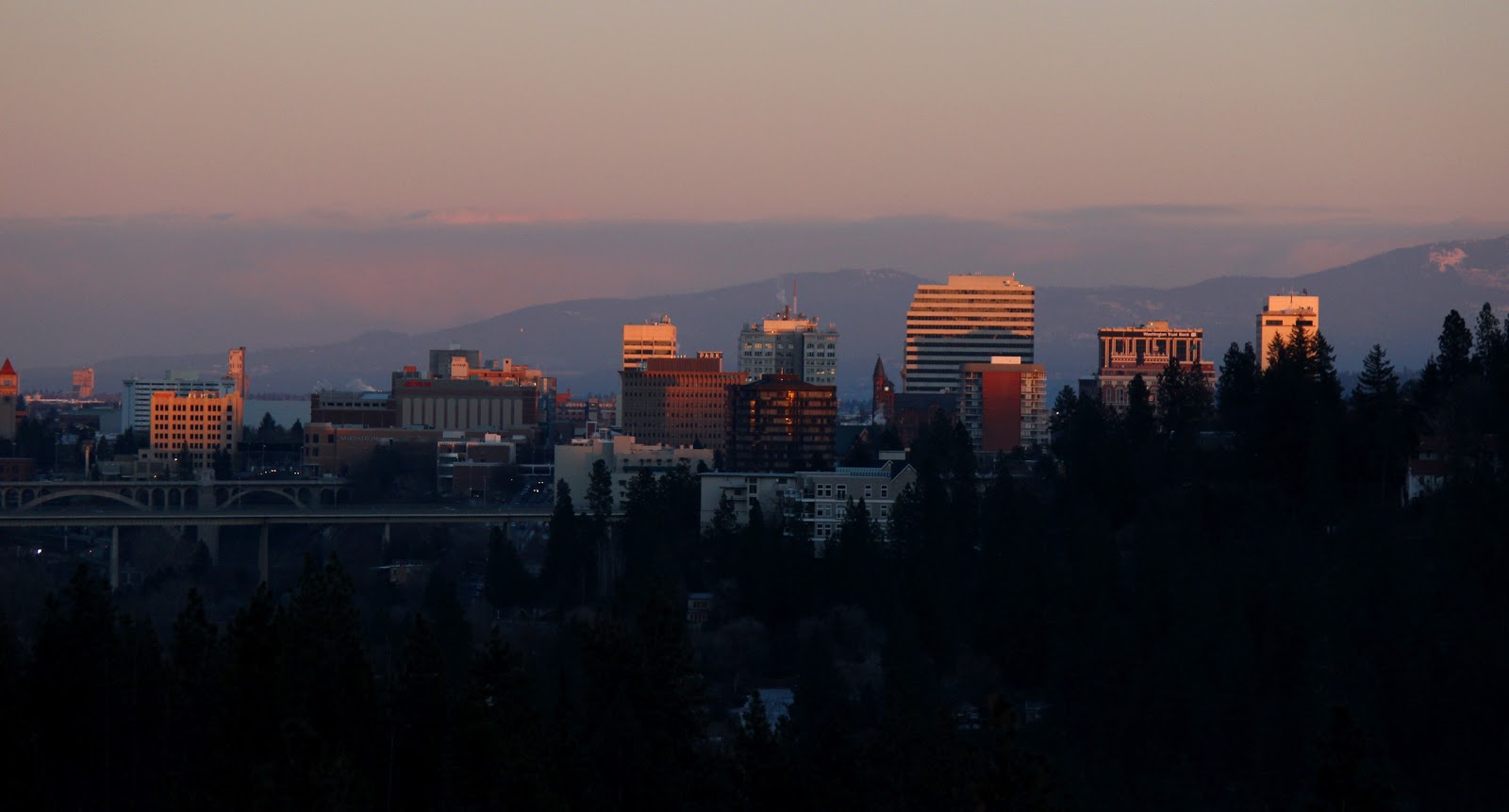
Sunset over downtown Spokane 
on a frozen day. 

Thursday, December 05, 2013

The Baptism of Slough-Keetcha


Stacy Nation-Knapper, a doctoral candidate in history at York University, recently published the baptismal record of Slough-Keetcha (Spokane Garry of the Spokane Tribe). Slough-Keetcha was baptized by David T. Jones on June 24, 1827 at the Red River School. 

The article can speak for itself, but as an aside, I found it interesting that my tribal group was identified as the "Spokane Tribe" as early as 1827. This is especially interesting considering Spokane was really the name of Slough-Keetcha's father, not the tribe. 

The full article is linked below:

Sunday, December 01, 2013

The Penultimate Battery Changers


My friend Shelly has a wonderful way of "suggesting" a specific course of action without actually committing herself to any part of the work. When we visited the white cliffs the other day, she said, "We'll take my rig, but we need to change the battery first. And by we, I mean you." 

"But I've never changed a battery," I protested. 

She popped the hood of her truck and said, "It's easy. Just remove these screws, lift the old battery out, put the new battery in, and then replace the screws. No problem." Then she turned and simply went back inside the house. That's what we call faith.   

Thankfully, I was not alone. I brought my friend Stephen to share my struggle with that old corroded battery. For a moment, we could only manage to look at each other helplessly. Then we argued over which one of us was the least likely to change a car battery. One of us said, "I'm the last one you'd ever expect to do this." 

The other said, "No, I'm the last." 

"Fine," the first answered, "Then I'm the penultimate person." Then we had to argue over who got to be the ultimate (the last) and the penultimate (the second to the last). Meanwhile, the battery sat unchanged inside the car. 

Using words like penultimate made me feel suyepi (white). The only reason I know that word is because of my experience with the Spanish language. I suspect the same is true of Stephen. 

Finally, I said, "How many gringos does it take to change a car battery?" And we laughed. 

In the end, we discovered that Shelly was right all along. Changing the batter really was quite easy, but just before she tested the new battery, I had a horrible thought. "What if we put the positive and negative connections in the wrong place?" I had a nightmarish vision of the car bursting into flames. But she turned the key and the engine roared to life. What a relief! 

We're both word nerds at heart, Stephen and I. We deal in words like penultimate, not in wrenches, metal bolts, or car batteries. Even so, it was very kind of Shelly to provide a well-rounded education in auto-mechanics.  


Later that day, Shelly took us to an abandoned mine shaft where we found a wrecked car from the 1930s. I thought about labeling these pictures with a joke about Stephen inspecting the damage after Shelly's car burst into flames. 

Shapes


The cliffs near Kewa were spectacular in their own right, but we also discovered strange shapes, presumably created from a mixture of water and natural clay deposits. Some of the shapes were perfectly round, like the image above. 


Others shapes were organic, but with small holes in the center. 


The clay broke away from the main wall of the cliff in layered chunks. 


In this photograph, the large chunks are darker than the small shapes. This is due to the difference in moisture levels. By the time I got home, the small shapes were already dry; however, the large pieces were still damp. 

Homeless


This story has already made the rounds on Facebook, but I was inspired to hear the voice of the Mormon bishop who dressed up as a homeless man in order to share a lesson in compassion. He acknowledged that some people asked him to leave the church, but I especially appreciated his last comments when he said that anyone might respond in a similar way. Sometimes we all need reminders in non-judgment and compassion. 

Romero


Recent conversations have reminded me that Monseñor Oscar Romero of El Salvador spoke powerfully against the agents of genocide. He used his office to denounce the murder of his fellow countrymen, and he himself paid the ultimate price. A gunman assassinated Romero in 1980 while he celebrated mass. 

The day before his murder, Romero delivered the following sermon:

I would like to appeal in a special way to the enlisted men of the army, and in particular, to the ranks of the National Guard, and the police—those in the barracks.

Brothers, you are of part of our own people. You kill your own campesino brothers and sisters. Before an order to kill that a man may give, God’s law must prevail that says: “Thou shalt not kill!” No soldier is obligated to obey an order against the law of God. No one has to fulfill an immoral law. It is time to recover your consciences and to obey your consciences rather than the order of sin. The Church, defender of the rights of God, of the law of God, of human dignity, of the person, cannot remain silent before so much abomination. We want the government to understand seriously that reforms are worth nothing if they are stained with so much blood.

In the name of God, and in the name of this suffering people, whose laments rise to heaven each day more tumultuous, I beg you, I beseech you, I order you in the name of God: Stop the repression! 
The Church preaches its liberation just as we have studied it today in the Holy Bible – a liberation that includes above all, respect for the human person, the salvation of the people’s common good, and transcendence, which looks before all to God, and from God alone derives its hope and its force. We are going to proclaim today our creed in this truth

The video in this post contains Romero's original speech in Spanish, along with archival photographs of the genocide in El Salvador. 

Romero's clarity and courage are deeply inspiring to me.  

LinkWithin

Related Posts with Thumbnails