Tuesday, August 28, 2012

Takalik Abaj


On Monday, we drove to Coatepeque to see someone I knew from the mission, but we were never able to connect. Instead, we had lunch and continued on our way to visit Takalik Abaj, an archaeological site with features of both the Maya and Olmec cultures. 

Years ago, the site was named Abaj Takalik, which in the Maya Quiche language means "Rock Standing," so called for its many standing altar stones. However, the Quiche language typically places the noun after the adjective, which is different from the Spanish word order. Therefore, they reversed the words to make the name consistent with correct Mayan grammar: Takalik Abaj (Standing Rock).   


Takalik Abaj also has abundant vegetation, like this cacao pod. 


Hermana Castillo called this flower "Bird of Paradise." 


Dakota and Rhonda in the jungle. 


Dakota and I in the jungle. 


In some places the vegetation completely covered the sky. 


Steps of an old temple. 


There is also a small zoo on site. 
This crocodile never moved. 


Hermana Castillo called this bird quiebrahuesos (the bone breaker). 


I don't remember the name of this animal with the sad eyes, but it was Rhonda's favorite. She put her face up to the cage and started talking to the animal in a sweet, high pitch voice, "Oh, you are so cute!" She went on like this for a short while, until the animal grabbed onto the cage with both hands and started shaking and hissing. We all laughed that Rhonda's "cute" animal turned out to be quite fierce. 


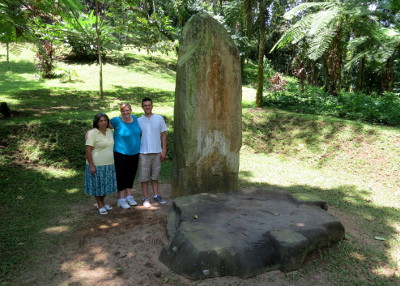
This altar stone faced the west and 
was related to death and the underworld. 


The guide explained that this small complex was a temazcal or a sweat bath, much like the sweathouses of today. The only difference is that these baths were reserved for the rulers of the city. 


Perhaps the most interesting aspect of the whole tour is the fact that all of the altars are still used for Mayan ceremonies. Next to each of the ancient stone altars is a new altar that allows the Maya people make offerings of fire without damaging the old altars. 

Monday, August 27, 2012

Raul


On Sunday evening in Colomba, we also visited my old friend Raul, his wife Bacilia, and their children. Of course, we all had to take pictures together. 


Raul and his family still live in the same house as they did twenty years ago, a full 118 steps down from the main street. 

El Cementerio


On Sunday afternoon in Colomba, our two families started out to visit the cemetery, but we turned back because of a torrential rain. In the photograph below, Dakota is drenched from the downpour. 


A while later, the rain stopped and we all decided to make a second attempt to visit the cemetery. Along the way, we saw this old swimming pool that had been converted into a makeshift soccer field. 


The two photographs above show a couple different scenes of Colomba with the rain clouds making a second return for the day. 


We finally arrived to pay respect 
at the grave of my dear friend Arnoldo Castillo. 


We had just arrived to put flowers on the grave, when I heard Emilia shout, "¡AquĆ­ viene el agua!" (Here comes the water!) The sound of rain approached like a wave without warning. Everyone ran and took shelter in a nearby chapel. 


The rain was visible from the window. 


Dakota in the chapel window. 


The rain eventually calmed 
and Yanet placed flowers on the grave. 


Emilia and her husband. 


The mist and the rain over the hills of Colomba. 


A view of the cemetery chapel. 


The Castillo grandchildren playing in the chapel. 


Dakota with the grandchildren. 


Emilia and Yanet. 


At the end, the rain threatened to fall a third time, so David ran home and brought the truck. The while group of us piled into the back of the truck and rode home. 

Sunday, August 26, 2012

Salvador


After attending church in Colomba, Dakota gathered the Castillo family together to present the hymn "Savior, Redeemer of My Soul" (Salvador, Redentor de Mi Alma). This particular version of the song was arranged by Dallyn Vail Bayless and is especially soulful and stirring. As soon as he opened his mouth to sing, a spirit of calm filled the room and bound our hearts together. The effect was both surprising and amazing; almost everyone wept as Dakota sang.    


Emilia.


David.


Hermana Castillo.


A little later, Rhonda played ball with the children. 


Overall, we simply enjoyed having our two families together. 

Friday, August 24, 2012

Colomba


We left Quetzaltenango after 7:30 in the evening and began the long drive down to the coast. Before we came to Guatemala, just about everyone told us to avoid driving at night, and now by pure necessity we had to break the only consistent rule we ever received. The road was long, winding, and very dark, and to make matters worse, we had to drive right through the middle of a torrential rain. Lightning flashed all around and the headlights from oncoming cars practically blinded us. We also had to cross dozens of speed bumps as we passed through every village and town. Some were clearly marked, while others seemed to appear out of no where. Needless to say, it was a harrowing, miserable drive. 

We finally arrived in Colomba at about 10:00 at night. The Castillo's house is totally different, so I wasn't sure if we had arrived in the right place, but then we say Yanet standing in the road. She smiled and we felt an immediate sense of relief. 


The next day, we attended the Colomba Branch. Twenty years ago, the branch was a struggling congregation of about 25 or 30 people, but now the church has about 70 or 80 active members. Unlike before, they have enough leadership to direct the meetings. 


Hermana Yanet prepared flowers for the cemetery. 


Chato's family. 


RaĆŗl was a close friend many years ago. As soon as he entered the room, he recognized me and smiled. Yanet had told him that I was coming, but he didn't believe. 


I don't know who this boy belongs to, but he insisted that I take several pictures of him. 


The central park of Colomba is very different. At one time, the park was open and clean. Now it had been completely swallowed by market vendors. 


Years ago, we lived in this building when it was called Tienda Granada and was colored bright orange. Now it is divided into several sections. It once sold agua ardiente (fire water), but now the entrance is a church of RĆ­os de Aguas Vivas (Rivers of Living Waters). 


A street in Colomba. 


The Castillo family welcomed us into their home. 

Back to the Rotonda


After seeing the temple, we took the taxi back to the Rotonda to get our car. By the way, I forgot to mention that a pedestrian bridge was also built so that people can avoid traffic when they cross the street. We crossed the bridge and took this picture of the Rotonda at night. 


Here is a nighttime picture of the giant archway that I mentioned in a previous post. 


This is a picture of El Bosque and all the cars still parked behind us. We had to wait at least another half hour for everyone to finally leave. 

El Templo


From Central Park, we took a taxi to the new LDS temple that was dedicated less than a year ago. Like so many other temples, it sits on a hill overlooking the entire city. The gates were already closed, but that did not stop us from enjoying the peace and beauty of the temple site. 

These photographs were taken just as the sun had already set. 


This is a larger version of the same photograph. You can click on this picture of the temple to download a larger copy of this image. 

El Parque Central de Quetzaltenango


When we stopped at the Rotonda, we saw that the door to the LDS Church was open. This is the chapel known as El Bosque. Rhonda suggested that we go inside. We saw other cars parked on the basketball court, so we parked there as well. We were in the building for only a few minutes, just long enough to use the bathroom and to reminisce about old times, but when we tried to leave, we saw that dozens of other cars had already parked behind us. Apparently a conference was just about to begin. By the time we asked people to move their cars, the conference already started. We would have to stay until the end of the conference two hours later. 

Hermana Yanet de Castillo was expecting us to arrive in Colomba by 5:00 that night. Now that we were stuck behind all the those cars, there was nothing to be done. We would just have to wait. We even tried to call Hermana Castillo to let her know about our delay, but no one answered. 

For just a moment, I stood there fretting about the next two hours, but then a microbus stopped at the curb and a man jumped out to holler the destination: Parque Central (Central Park). I motioned for Rhonda and Dakota to follow and all three of us jumped aboard the tiny, dilapidated bus. Anyone who has traveled in Guatemala knows the buses; you are squished like sardines with friends and strangers alike. Most of the them have no air conditioning, so the ride is hot, dirty, smelly, and uncomfortable, but it's all part of the experience that I wanted to share with my family. That part hasn't changed in twenty years.    


We arrived at Central Park and I was so happy to share the sights with Rhonda and Dakota. 

There is so much history. For example, this old Catholic church was built in the 1500s, but it was largely destroyed by an earthquake a few hundred years later. Only the facade remained. The surviving portion of the church was preserved because of the artistry and beauty and the new church was built directly behind. 


Detailed carvings adorn the old facade. 


Years ago, my father and I took a picture
in front of these great doors. 


When we arrived, the park was bustling with young people. 


A man was playing the guitar. 


Rhonda and Dakota stood to pose for this picture on one of the many narrow streets. In this picture you can see the cars passing just a few feet away.  

LinkWithin

Related Posts with Thumbnails