Showing posts sorted by relevance for query history. Sort by date Show all posts

Sunday, July 11, 2010

Spokane River History Tour


Four or five years ago, my friend Deb Abrahamson asked if I would represent her during official state or local meetings, in the case that she could not appear herself. I agreed, but she never called on me again, until yesterday.

Deb was scheduled to speak during the Spokane River History Tour, sponsored by the local Sierra Club and the Center for Environmental Law and Policy (CELP). A personal matter prevented her from making the presentation, so she asked me to appear in her stead. With less than an hour notice, I got myself ready and gave an impromptu speech to a group of about twenty five people. As much as possible, I tried to remain faithful to her topic and address the relationship of the Spokane Tribe to our rivers.

A variety of local experts addressed other aspects of the river's history, including Jack Nisbet, Bill Youngs, and Rachael Paschal Osborn.

In the photograph above, Larry Cebula (left) introduces Bill Youngs (right). (Larry Cebula is the author of "Plateau Indians and the Quest for Spiritual Power, 1700-1850.")


Local historian and author Jack Nisbet also addressed the group. I recently had the opportunity to meet Jack when he dug brown camas near Spangle, WA with a student group from Wellpinit Middle School.


Bill Youngs is a local historian and history professor at Eastern Washington University. During the Spokane River History Tour, he addressed two main topics. First he spoke about the founding of the city of Spokane by James Glover. Second, he spoke of the 1974 World's Fair that transformed the heart of the city.

A portion of Bill Youngs' comments bear repeating. He wrote:

During the spring of 1873... James Glover - the founder of Spokane - was traveling through the Inland Northwest looking for a place to establish a town and make a fortune.

After journeying from Lewiston by horseback for several days through the lightly settled Inland Northwest he came to Spokane Falls. Glover knew at once that this was the place to build a town. He knew that a waterfall was the ideal source of power to grind grain and mill timber.

Glover also recognized that the falls were a thing of beauty. Later in life he remembered sitting beside the river on a rock during his first morning in Spokane. "I was enchanted," he wrote, "- overwhelmed - with the beauty and grandeur of everything I saw. It lay just as nature had made it, with nothing to mar its virgin glory."

A century later, stumbling upon the falls, he might have "held that thought" and proposed that the falls be set aside as a National Park. (One of the early visitors to Yellowstone, by the way, thought that Spokane Falls and its environs were even more beautiful than the nation's first national park.)

But James Glover grew up in the age of robber barons, industrial tycoons, and city-builders. Setting aside his realization of the beauty of the falls, he saw dollar signs rather than natural beauty, and said of the setting, "I determined that I would possess it."
I've taken this quote from a website promoting the restoration of Spokane Falls, but these words are almost identical to the ones Bill Youngs told us as we overlooked the Spokane River. Personally, I had never heard this story before. Many times I have myself sat captivated by the beauty of Spokane Falls, and I can hardly conceive that anyone could think to possess such a magnificent, living thing. James Glover not only came to possess the falls, but nearly destroyed them beneath the urban development he instigated.

Thankfully, Bill Youngs did not conclude the story with only an account of Glover's personal ambition or tales of environmental destruction. He also recounted the story of urban renewal brought about by the World's Fair (Expo '74).

Youngs wrote the book "The Fair and the Falls: Spokane's Expo '74 : Transforming an American Environment." The book recounts the history of the river and the fair. Up to that point, Spokane was the smallest city to ever host a world's fair, and arguably, Spokane's fair created a more lasting benefit to the local community than other fairs.

The site of the fair was once a scene of urban decay. The river was completely choked by concrete and steel, railroad trestles and industrial buildings. The city of Spokane used the fair as an opportunity to restore the heart of the river. The old buildings were demolished and replaced with a beautiful 100 acre park: Riverfront Park.

As an aside, I was only three years old during Expo '74, but I still remember opening day of the fair. I remember looking up into the sky and seeing millions of helium balloons mingled with hot air balloons.


The events of the day were filmed by a man named Easy; a video will eventually be released on Community-Minded Television. Easy and I first met last year when I gave a local history presentation at Drumheller Springs.
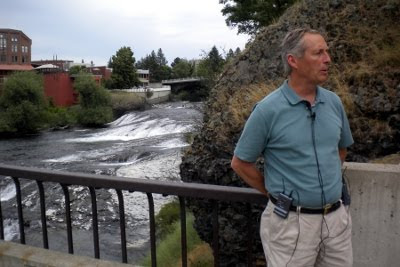


Speed Fitzhugh represented Avista during the tour. He spoke about a recent policy change that will allow water to flow over the falls twenty four hours a day, seven days a week. Previously, Spokane Falls would run completely dry during the summer months as all the water was diverted for electric power.


The Sierra Club was instrumental in negotiating an agreement with Avista to allow Spokane Falls to flow during the summer. Rachael Paschal Osborn addressed the group during the history tour and spoke of the Sierra Club's efforts.


The group concluded the Spokane River History Tour near the site of the World's Fair. The former American Pavilion is visible in the background (left), as well as the old Clock Tower and the Imax Theater.

Monday, May 15, 2006

Project Self-Sufficiency


School busses parked in "downtown" Wellpinit.
Copyright © 2006 Barry G. Moses.


Controls on an abandoned firetruck.
Copyright © 2006 Barry G. Moses.

The Community Colleges of Spokane and Spokane Tribal TANF recently created a collaborative contract for adult learners and hired me to teach a class called Project Self-Sufficiency. I present lessons twice a week to a group ranging from 10 to 16 students. So far, it has been really fun.

I enjoy teaching in Wellpinit because of its proximity to my family and cultural center, but also because I love to see the layers of history everywhere evident. For example, I recently posted several photographs of an abandoned house from the 1930s or 40s. Right behind my work site is an old fire truck from many years ago. Some people would call it junk, but it holds my attention and excites my imagination.

As a history teacher, I see history everywhere. History is not dead, but lives in everyone and everything.

Wednesday, June 24, 2009

Independence Rock


Independence Rock stands above the high plains of Wyoming as a natural monument to the early pioneers of the Oregon Trail. Travelers hoped to reach Independence Rock before the 4th of July to ensure an arrival to the Oregon Country before the first snowfall. Many passersby inscribed their names on the rock, though contemporary inscriptions are punished. One generation's graffiti is another generation's treasured artifact.

My children and I climbed the rock and enjoyed the wonderful view.


Of course, I had to do the LOOK, yet again, from another another landmark. Is this another tradition in the making?

On a more serious note, I recently spoke to a group of LDS missionaries regarding my persepctive of history. The pioneer legacy is something they obviously cherish, especially as they consider the religious conviction that compelled their ancestors to brave the unknown dangers of the frontier. And yet, the opening of the various historic trails caused the decline of indigenous cultures in western North America. The frontier opened a new chapter of discovery for the American pioneers, but marked the heartbreaking decline of indigenous lifeways.

Even as I stood atop Independence Rock to see the endless Wyoming plain, the effects of that place reached my ancestors hundreds of miles away. More than a half a million people crossed that place en route to the Oregon Country, which at that time included the traditional territory of my Spokane and Kalispel Salish ancestors. My great grandparents directly experienced the effects of the westward migration, often through tragedy, sickness, forced assimilation, and death.

How can I reconcile these opposing forces of history? How can I reconcile the anger and the grief with the equally compelling desire to create peace in the world today? No answers immediately appear, but perhaps one of the great mysteries of life is that sometimes horrible things happen, and we are left with the choice of how to respond. In the end, history is done, and my personal response of either bitterness or acceptance is the only choice that remains.

Sunday, June 15, 2014

Living History


The Friends of Spokane House hosted a living history exhibit this weekend where participants dressed in clothing from the time of the original trading post (1810) and displayed traditional crafts. As part of the event, my Uncle Pat and I had the opportunity to speak to people about the history of the Spokane Tribe. 


Spokane House introduced many new items into our local culture, like guns and metal pots. They also brought decorative items, like glass beads from Italy. 


The traders persuaded the people to deliver beaver pelts in exchange for trade items. Beaver skins thus became a kind of currency or money. 

As an interesting side note, one of the earliest Salish words I learned in my childhood was a word for money. Years ago, I sometimes asked my father to take us to the movies or buy ice cream, and he would often respond by saying, "We got no sqlew." I always understood his meaning, "We have no money," but it wasn't until I was an adult that I realized the true meaning of this word: sqlew is the Spokane term for beaver. It's interesting to me that Spokane House influenced my family almost 200 years later. 


The beaver pelts were used to make top hats in Europe. 


Camp musicians. 


The grave of Jacco Finley near Spokane House.


Dakota near the Northwest Company flag. 

Tuesday, May 17, 2011

Elderberry Flutes


Last Thursday, a group of twelve students gathered at the Adult Education Center on Monroe to make elderberry flutes in a special workshop funded by the IEL Equity Committee. The elderberry project was part of an equity mini-grant that was intended to promote diversity awareness at the IEL by:  

  1. Offering students a greater understanding of local tribal history and cultural practices.
  2. Drawing a tangible connection between the cultural history of this region and the local ecosystem.
  3. Demonstrating to students that math, science, and cultural awareness have inter-connected and real-world applications.
  4. Providing students with a tangible end-product (the elderberry flute), thereby increasing the sense of connection to diverse cultures and practices.
  5. Increasing diverse perspectives within the curriculum.
  6. Improving the student climate at the IEL by creating a sense of cooperation and shared purpose.     


The mini-grant provided funding for Tim Corcoran, co-founder of Twin Eagles Wilderness School, to offer technical instruction for the flute making workshop. He gave the students detailed knowledge regarding the practical skills of the project, along with his personal support for the individual learning process. As students encountered challenges, Tim demontrated a natural ability to balance instruction with encouragement.

Two IEL instructors also participated in the workshop and added a variety of learning perspectives to the project. Carole Parks spoke to the students regarding the science of sound, while Barry Moses spoke about the history of flute making within the Salish speaking tribes of Eastern Washington.


The flute making project had a positive impact on academic achievement.

Several of our GED students got a practical, hands-on lesson regarding measurment and the division of fractions as they learned about the proper placement of the flute holes. They also practiced skills related to geometry as they learned to fashion the wood in the correct angle to produce sound.


In addition to learning about tribal cultures in Washington State, many students made a deeper connection to their own cultures.

One participant recently finished ESL and enrolled in the reading program. She was born in Vietnam, and as she worked on this project, she spoke about the parallels between Native American flutes and the bamboo flutes of her birthplace. Another participant is enrolled with a tribe in the eastern portion of North America. She spoke of deepening her connection to her ancestral roots and of wanting to teach her own children how to make elderberry flutes.


This student gave permission to post his picture online.


As he completed his flute, he made an inscription in the Tagalog language: "Memories to the future." 

This project increased cultural awareness and also created a greater sense of community at the IEL. Some expressions of community were small. For example, I saw one student smile for the first time since he enrolled several quarters ago. Others got to experience that magical moment when a dead stick of wood suddenly produced music.

As the workshop ended, one student said, "Thank you SO much for doing this. I have never done something like this, not even during grade school."

As a follow-up exercise, some of the students wrote essays regarding their experience at the workshop. One student wrote: "At the end of the project, I found myself wanting to create more native and cultural projects. It was a very good experience for me to see how other cultures worked through problems and overcame making a flute with a lot less supplies than I had. It amazes me..."

Wednesday, June 24, 2009

Martin's Cove


From Wikipedia, we find a partial history of Martin's Cove, Wyoming:

"In November 1856, about 500 Mormon emigrants in the Martin Handcart Company were halted for five days in the Cove by snow and cold while on their way to Salt Lake City. That autumn two handcart companies, the Willie and Martin companies, began their journey dangerously late and met disaster in the cold weather of Wyoming. Although the number who died in the Cove is unknown, more than 145 members of the Martin Company died before reaching Salt Lake City. A few days prior to their arrival at Martin's Cove, the company was met by a small rescue party with food, supplies, and wagons that LDS Church President Brigham Young had sent from Salt Lake City, Utah. On November 4 the company and rescuers forded the bitterly cold Sweetwater River and sought shelter in the cove."

The LDS Church currently operates a visitor center nearby.


Rhonda's father and step-mother are serving as missionaries at the Martin's Cove site. They invited us to visit them and to participate in a personalized re-enactment of the handcart companies.


Rhonda's mother also visited Martin's Cove. Several months ago, her mother suffered a heart attack, so she could not hike the trail with us. But in the spirit of the historic handcart companies, we committed to carrying her. She was a little embarrassed, but it was an honor to pull her in the cart, and it added a sense of realism to the re-enactment. And besides, she otherwise would have never gotten to see this place from the sacred history of her religion.


In all, we hiked more than five miles, pulling a handcart the whole way. We were exhausted and sunburned by the end, but we felt happy. I love visiting places in a way that allows us to participate in history and culture.

Tuesday, January 20, 2009

Inauguration


Whitney documented her observation of the inaugural ceremony, while her sister McKenna looked on.


My daughters and I observed Barack Obama take the presidential oath of office at 9:00 a.m. this morning via live television. We saw history unfold right before us and my daughters documented the event by drawing portraits of our new president. They arrived late to school, but the inauguration was too important to miss. The secretary said several others were also late to school for the same reason.


I encourage all my readers to follow the example of my daughters and to take a few minutes to write in your journal, or to start a journal. If you will document your thoughts and feelings of these historic events, you leave a treasure for future generations. As a genealogist and high school history teacher, I cannot emphasize enough the importance of leaving a personal record for those who follow. As we bear witness to history, whether momentous or mundane, our descendants will thank us.

Sunday, May 05, 2013

The Garry Bell


This post is dedicated to my friend Brian Huseland who asked me to photograph the Spokane Garry Bell. This history of the bell is engraved on a granite monument that stands in the heart of Chief Lot Cemetery in Wellpinit, Washington. The engraving reads: 

The Story of the Bell

Thomas Garry, the adopted son of Chief Spokane Garry, took care of his father’s bell. Thomas told Sadie, his wife, the history of the bell—how his father received the bell from the original First Presbyterian Church and took it to his cabin on Pleasant Prairie. A whiteman stole his farm. Spokane Garry rescued his bell taking it by horse back to Indian Prairie where he was helped by three friends: William Three-Mountain, Solomon Scott, and Thomas’ brother Tidas Williams, to set up a new church for Christ and the bell. After three years they were forced by whitemen to move again, this time to Spokane River Church. From the rising waters of the Coulee Dam, Thomas fled to Wellpinit with his father’s bell. Now, his wife Sadie has had the bell taken from rusting junk to be polished and placed on this monument as an everlasting memorial to the Garry’s. 

A more complete version of this history appeared in the Spokane Daily Chronicle on July 20, 1973 in an article titled: Historic Garry Bell Part of Indian Memorial Rite


The monument stands on the lower end of the cemetery. 


The story of the bell...


A rusted angel...


Chief Lot's tomb in the late afternoon...


Brian asked me to photograph any engravings or dates on the bell. I didn't see any dates or numbers, but I did see an engraving that presumably had some reference to the manufacturer of the bell. One side reads: "SUTTONBR S&BELL."


The other side reads, "INDIANA PA."


I went back the next day to get 
a better view of the bell at midday. 


Chief Lot's tomb at midday. 
The ancient initials of Jesus appear on the cross. 


The inscription on Chief Lot's gravestone reads: 

In memory of Chief Lot
Died: April 6, 1902

Chief Lot Cemetery

Who, profoundly stirred by the Holy Spirit, went to Washington D.C. with the request: ‘I like a school house.’ Rhode Island Women’s Indian Association heard his prayers from a mission and school for his people and sent Miss Helen Clark. His dream at last fulfilled: ‘My heart is big now.’ Miss Clark said of the Spokanes: ‘—as a whole, they are well behaved and respectable.’

Could any greater compliment be paid to a race?
Dedicated: Oct. 23, 1969

Sadie Boyd Garry 

*

I do have to admit that being well-behaved and respectable is actually not the highest compliment someone could pay to my race, or any other race. When they called us well-behaved, does that actually mean that we did not resist the settlement of our country by the American masses?

LinkWithin

Related Posts with Thumbnails