st'ulixʷ č nwist (Heavenly Land) performed by Barry Moses in the Spokane language and recorded by Stanton Cobbs at Summit Sound Studio in Tum Tum, Washington - 2016. Translation and back story to come.
Showing posts with label Christianity. Show all posts
Showing posts with label Christianity. Show all posts
Monday, November 07, 2016


xʷl stem'...?
"Why Will You Wait?" performed by Barry Moses in the Spokane language and recorded by Stanton Cobbs at Summit Sound Studio in Tum Tum, Washington on November 5, 2016. Back story and translation to come.
Monday, November 02, 2015
All Souls

l' qe i st'mčʔelt u qe čxʷuymntm łuʔ sntmtmneytn xʷl hecyaʕ snxpew's sxlxalt, u qe wičntm łuʔ qʷamqʷmt čʔul'sey'utyeʔ u hec c'ek'ʷmi łu l' skʷkʷʔec.
My daughter and I visited the cemetery for All Souls Day, and we saw the beautiful candles shining in the night.
Mi hija y yo visitamos el cementerio para el Día de Todas las Almas, y vimos las bella candelas que brillaban en la noche.


Thursday, July 09, 2015

Wednesday, January 14, 2015
Kiowa Church Hymn
This church hymn was performed in the Kiowa language. I am not sure if the orthography is current or correct, but this was how it was written in the booklet that accompanied the album. It says:
äh’ho dawk’yäee, dawk’yä täom gyă, gyă oboidaw.
According to the composer, the song translates as:
Thank you Son of God. God's help is real.
Monday, August 11, 2014
Merchants in the British Pageant

As I mentioned earlier, Rhonda's brother and his family were in the previous cast, so we got to see them perform during our rehearsal week. In this picture, Mike and Gaylene were dressed for the British Pageant.

McKenna and Preston dancing.

These banners were displayed for the British Pageant.

Oh say, what is truth?
'Tis the brightest prize
To which mortals or Gods can aspire.
Go search in the depths where it glittering lies,
Or ascend in pursuit of the loftiest skies:
'Tis an aim for the noblest desire.


Bagpipers played at the beginning of each performance.

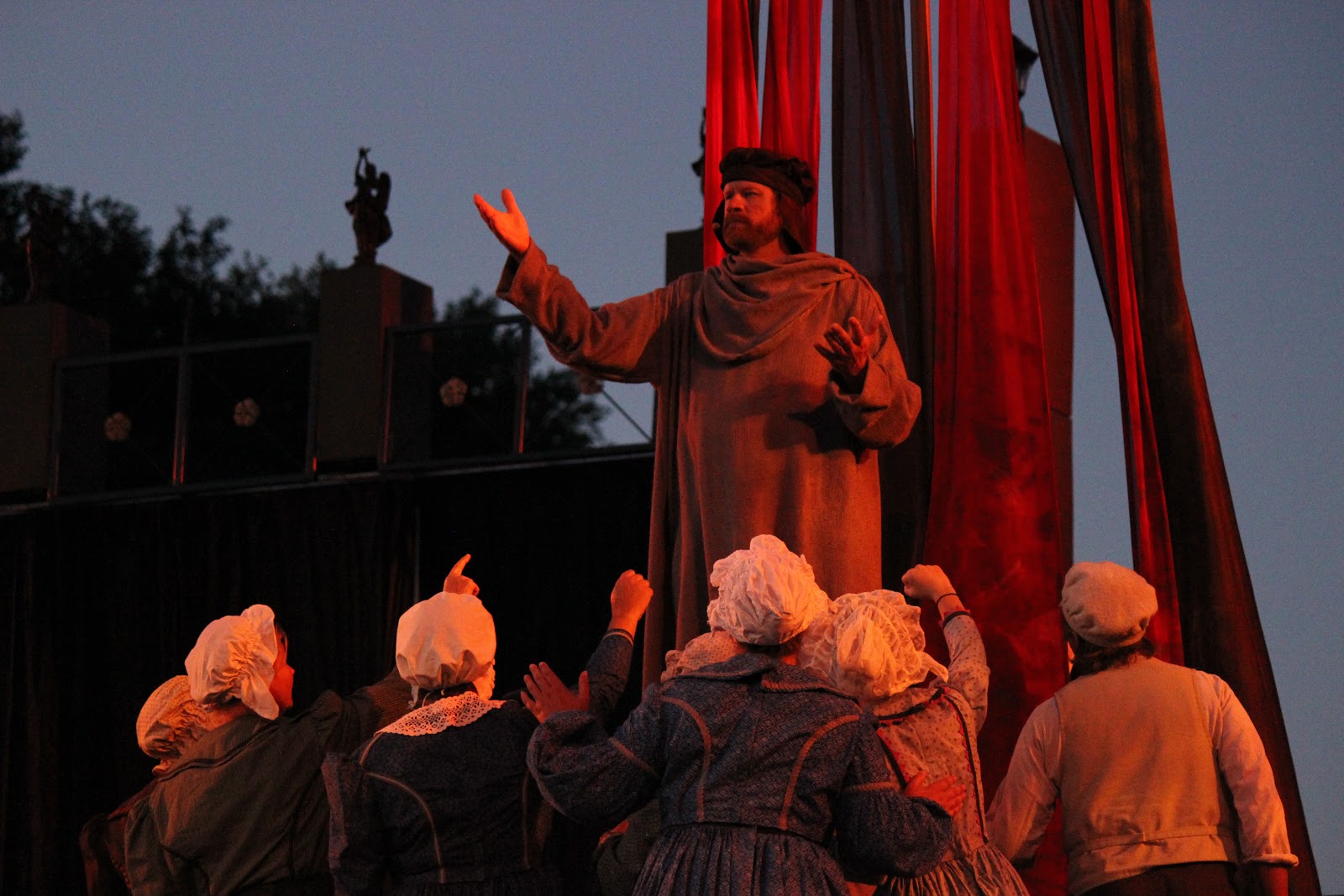
The British Pageant opened with a scene that depicted the Protestant Reformation and included quotes from Anne Askew and William Tyndale. '
Anne Askew was a member of court under King Henry VIII. She was charged with heresy and executed for saying, "I would sooner read five lines in the Bible than hear five masses in the church." The British Pageant softened her quote somewhat by having her say, "I would rather hear five lines of the Bible in English than hear five sermons in language I do not understand."
William Tyndale once said, “If God spare my life ere many years, I will cause the boy that drives the plow to know more of the scriptures than you!”The reformers challenged the religious authorities of the day to bring about the Bible in English and to make God accessible to the common people.

Maddie...

Gaylene...

Sailors in the British Pageant.
Tuesday, April 01, 2014
Near-Death Experience

As a young girl, Mishayo was diagnosed with cancer and had a near-death experience. Now she tours the country telling her story to anyone who will listen, including a recent event at the Spokane Tribal Longhouse.
She described many of the classical elements of a near-death experience, such as floating above her body and seeing the reaction of doctors and nurses. After leaving her body, she witnessed a series of terrifying images: a woman with no eyes, a man impaled by knives, a lake of fire, and the endless torment of those who rejected God. She cried out, "Jesus, if you're real, please save me!"
Jesus appeared and delivered her from the flame.
She asked, "Why did I have to see this? Was it because I was angry at God for getting cancer?"
In her vision, Jesus explained that she had to witness the horrors of hell so that she could come back to earth and warn the people. Jesus named several specific evils, including alcohol, drugs, tobacco, casinos, and abortion. But in all cases, she said the people were assigned to hell because they chose sin before God.
At the end of her presentation, she led the people in the classic salvation prayer used by many Evangelical churches. Then the people formed a line and she lay hands on them all.
Regardless of one's theology, the event was striking for several reasons. First, the young girl spoke with a rhythmic, almost trance-like quality. There was no doubt in my mind that she was 100% sincere in her belief. Second, her testimony produced a remarkable, cathartic reaction among the people. By the end of the meeting, dozens of people were holding one another, sobbing, and praying.
Her message was overtly Christian, but something about her mannerisms reminded me of other Native American prophet movements, like those founded by Wovoka, Smohalla, or John Slocum. According to one theory, prophets tend to arise in times of distress or rapid social change, such as the destruction of Native cultures by American and European powers. In the case of Mishayo, the distress seemed to revolve around the despair of reservation life caused by alcohol and drugs.
Many were inspired by her message; however, I'm sure that some will reject it. In the end, it will be interesting to see the impact of her message on our community.

A man sang Gospel music before the presentation.

The longhouse is filled with Catholic imagery, which is ironic considering the girl's vision. At one point, she reported that she saw Mary crying because people were worshiping her instead of Jesus.


A family member introduced the event.
Tuesday, December 24, 2013
pipit nčputetn sxlxalt

The recent winter solstice caused me to reflect on a Salish version of words related to Christmas. Obviously, Christmas was not originally an indigenous concept, but the majority of our people have accepted it, and Christmas is now an inextricable feature of our cultural landscape.
The Montana Salish dictionary described Christmas as nwel, which would seem to arise from a French influence.
The Spokane Dictionary did not provide a translation for Christmas; however, an old Rawhide Press from the late 1970s advertised Salish Christmas cards with the following inscription: pipit nčputetn sxlxalt (happy most sacred, holy day).
Sunday, December 01, 2013
Homeless
This story has already made the rounds on Facebook, but I was inspired to hear the voice of the Mormon bishop who dressed up as a homeless man in order to share a lesson in compassion. He acknowledged that some people asked him to leave the church, but I especially appreciated his last comments when he said that anyone might respond in a similar way. Sometimes we all need reminders in non-judgment and compassion.
Romero
Recent conversations have reminded me that Monseñor Oscar Romero of El Salvador spoke powerfully against the agents of genocide. He used his office to denounce the murder of his fellow countrymen, and he himself paid the ultimate price. A gunman assassinated Romero in 1980 while he celebrated mass.
The day before his murder, Romero delivered the following sermon:
I would like to appeal in a special way to the enlisted men of the army, and in particular, to the ranks of the National Guard, and the police—those in the barracks.Brothers, you are of part of our own people. You kill your own campesino brothers and sisters. Before an order to kill that a man may give, God’s law must prevail that says: “Thou shalt not kill!” No soldier is obligated to obey an order against the law of God. No one has to fulfill an immoral law. It is time to recover your consciences and to obey your consciences rather than the order of sin. The Church, defender of the rights of God, of the law of God, of human dignity, of the person, cannot remain silent before so much abomination. We want the government to understand seriously that reforms are worth nothing if they are stained with so much blood.In the name of God, and in the name of this suffering people, whose laments rise to heaven each day more tumultuous, I beg you, I beseech you, I order you in the name of God: Stop the repression!
The Church preaches its liberation just as we have studied it today in the Holy Bible – a liberation that includes above all, respect for the human person, the salvation of the people’s common good, and transcendence, which looks before all to God, and from God alone derives its hope and its force. We are going to proclaim today our creed in this truth
The video in this post contains Romero's original speech in Spanish, along with archival photographs of the genocide in El Salvador.
Romero's clarity and courage are deeply inspiring to me.
Monday, November 25, 2013
St. Ignatius

My daughter and I also visited St. Ignatius on the Flathead Indian Reservation. More than anything, I wanted to see the painting Christ as an Indian Chief, which was featured on the cover of Chad Hamill's book, Songs of Power and Prayer in the Columbia Plateau. This image absolutely fascinated me because of the syncretism of Native American and Catholic imagery.

I was also surprised to learn that the painting was modeled after Jerome Vanderberg.

The front of St. Ignatius.

The interior of the church was filled with religious artwork, like this statuette depicting the baptism of Jesus by John the Baptist.

The windows of the church.

The Last Supper depicted on the main altar.
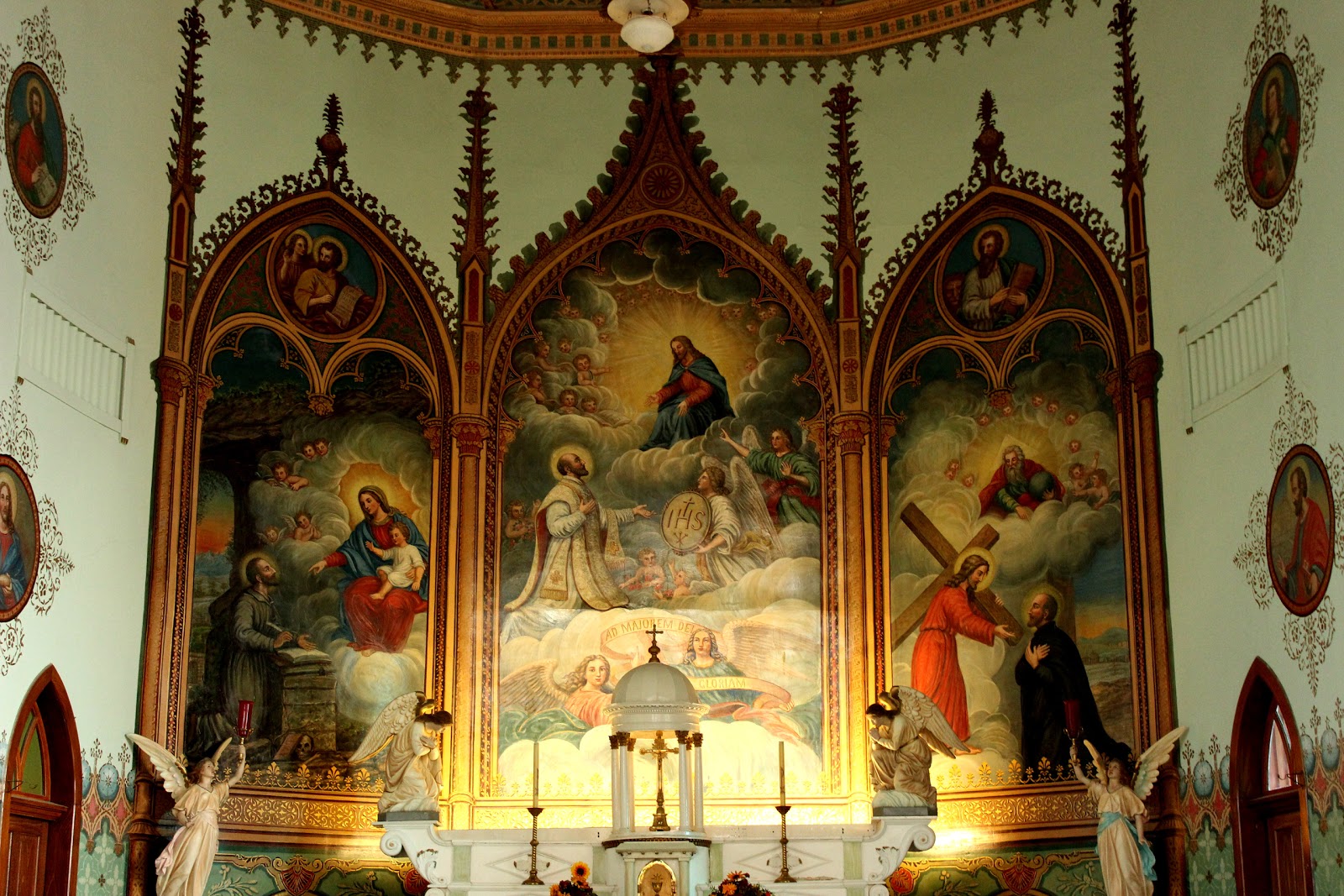
Frescoes painted on the wall behind the altar.
Wednesday, September 18, 2013
Our First Communion

As mentioned previously, I visited the special collections archive at Gonzaga University where I was able to handle several Jesuit documents written in the Kalispel language. I posted pictures of "Our First Communion," and now I am posting a different version of a similar First Communion text. This second book was also written by Father Kelly, but probably with a different audience in mind. It is similar, but has some differences.
The second Kelly text did not have an English version, so I attempted my own reverse translation. In some cases, it was difficult to know the placing of the lines, so I simply guessed based on where I thought they sounded best. A few times I was unsure of the exact word, either because the original was unclear or because my own Salish is limited. In any case, I hope this partial translation spurs interest in the old Salish texts and becomes a resource for further research.
I should mention that these photographs are posted with an understanding of "fair use." Since my translation and blog are new creations, I consider it acceptable to copy limited facsimiles for educational purposes. Gonzaga University owns the original documents, so I would encourage researchers to contact the special collections archive to see a complete copy of these papers.
My translation follows below. If I have made mistakes, I welcome suggestions or corrections.

Translation
of the Book Our First Communion
by Fa. William R. Kelly in the Kalispel Language
A long time ago, | there was nothing, | there were no humans.
2. kʷen’t łuʔ t k’ʷul’ncutn | k’ʷul’is esya teʔstem’.
Then the Creator | made everything.
3. łuʔ t k’ʷl’ncutn | k’ʷul’is łuʔ sp’q’niʔ | kʷen’t esya łuʔ kʷkʷusm.
The Creator | made the sun | then all the stars.
4. łuʔ t k’ʷl’ncutn | k’ʷul’is łuʔ sewłkʷ | kʷen’t łuʔ stulixʷ.
The Creator | made the water | then the land.
5. łuʔ t k’ʷl’ncutn | k’ʷul’is łuʔ es clcil | kʷen’t łuʔ skʷalulexʷ.
The Creator | made the trees | then the plants.
6. łuʔ t k’ʷl’ncutn | k’ʷul’is łuʔ xʷixʷey’uł | kʷen’t łuʔ es xʷexʷeʔe.
The Creator | made the animals | then the flying birds.
7. łuʔ t k’ʷl’ncutn | k’ʷul’is łuʔ swewł
The Creator | made the fish
kʷen’t nk’ʷuʔmntwis(?) łuʔ l’ sewłkʷ.
then he gathered(?) them in the water.
8. kʷen’t hoy łuʔ es ec’ew’t | łuʔ t k’ʷl’ncutn
Then finally at the last | the Creator
k’ʷul’is łuʔ sqltmixʷ | u łuʔ smʔem.
made the man | and the woman.
9. łuʔ es šʔit sqltmixʷ | šey’ adam,
The first man | that was Adam,
2. kʷen’t łuʔ t k’ʷul’ncutn | k’ʷul’is esya teʔstem’.
Then the Creator | made everything.
3. łuʔ t k’ʷl’ncutn | k’ʷul’is łuʔ sp’q’niʔ | kʷen’t esya łuʔ kʷkʷusm.
The Creator | made the sun | then all the stars.
4. łuʔ t k’ʷl’ncutn | k’ʷul’is łuʔ sewłkʷ | kʷen’t łuʔ stulixʷ.
The Creator | made the water | then the land.
5. łuʔ t k’ʷl’ncutn | k’ʷul’is łuʔ es clcil | kʷen’t łuʔ skʷalulexʷ.
The Creator | made the trees | then the plants.
6. łuʔ t k’ʷl’ncutn | k’ʷul’is łuʔ xʷixʷey’uł | kʷen’t łuʔ es xʷexʷeʔe.
The Creator | made the animals | then the flying birds.
7. łuʔ t k’ʷl’ncutn | k’ʷul’is łuʔ swewł
The Creator | made the fish
kʷen’t nk’ʷuʔmntwis(?) łuʔ l’ sewłkʷ.
then he gathered(?) them in the water.
8. kʷen’t hoy łuʔ es ec’ew’t | łuʔ t k’ʷl’ncutn
Then finally at the last | the Creator
k’ʷul’is łuʔ sqltmixʷ | u łuʔ smʔem.
made the man | and the woman.
9. łuʔ es šʔit sqltmixʷ | šey’ adam,
The first man | that was Adam,
kʷen’t łuʔ es šʔit smʔem | šey’ eve.
then the first woman | that was Eve.
10. adam šey’ łuʔ skʷesc | łuʔ es šʔit sqltmixʷ.
Adam was his name | the first man.
11. eve šey’ łuʔ skʷesc | łuʔ es šʔit smʔem.
Eve was her name | the first woman.
12. łuʔ t k’ʷl’ncutn | k’ʷul’is es šʔit xest,
The Creator | made it the most good,
kʷen’t es milk’ʷ xest | adam u eve.
then altogether good | were Adam and Eve.
13. łuʔ t k’ʷl’ncutn | t’k’ʷntes adam u eve
The Creator | placed Adam and Eve
łuʔ l’ es šʔit xest snq’ʷolłqtn, | łuʔ l’ xsulexʷ.
in the most good garden, | in the good land.
14. l’ šey’ adam u eve | axilm esya teʔstem’ | u łuʔ k’ʷl’ncutn cuʔuntm.
There Adam and Eve | did all things | the Creator told them.
xest sewneʔ łuʔ | sqʷlqʷelc k’ʷl’ncutn.
They listened well to the Creator’s speech.
15. l’ šey’ u es npiyelsmisti | l’ esya teʔstem’
There they enjoyed (?) | everything
then the first woman | that was Eve.
10. adam šey’ łuʔ skʷesc | łuʔ es šʔit sqltmixʷ.
Adam was his name | the first man.
11. eve šey’ łuʔ skʷesc | łuʔ es šʔit smʔem.
Eve was her name | the first woman.
12. łuʔ t k’ʷl’ncutn | k’ʷul’is es šʔit xest,
The Creator | made it the most good,
kʷen’t es milk’ʷ xest | adam u eve.
then altogether good | were Adam and Eve.
13. łuʔ t k’ʷl’ncutn | t’k’ʷntes adam u eve
The Creator | placed Adam and Eve
łuʔ l’ es šʔit xest snq’ʷolłqtn, | łuʔ l’ xsulexʷ.
in the most good garden, | in the good land.
14. l’ šey’ adam u eve | axilm esya teʔstem’ | u łuʔ k’ʷl’ncutn cuʔuntm.
There Adam and Eve | did all things | the Creator told them.
xest sewneʔ łuʔ | sqʷlqʷelc k’ʷl’ncutn.
They listened well to the Creator’s speech.
15. l’ šey’ u es npiyelsmisti | l’ esya teʔstem’
There they enjoyed (?) | everything
l’ esya l’ čen’ u ec’xił | u kʷtunt es npiyelsi.
and in all things as they were | and they were greatly happy.
16. hu p’n nk’ʷuʔ sxlxalt | łuʔ sxʷelmn čxʷuymis
But one day, | the devil visited them.
kʷen’t kʷupis | č’ t’ey’eʔ | adam u eve.
then he pushed them | toward evil | Adam and Eve.
17. l’ šey’ (kutleelis) łuʔ adam u eve qs t’ey’eʔ.
That was how ____ (?) Adam and Eve became bad.
18. adam u eve nunxʷeneʔmis łuʔ sxʷelmn.
Adam and Eve believed the devil.
ssewneʔmis łuʔ sqʷlqʷelc sxʷelmn.
They listened to the devil’s speech.
19. u tl šey’ | u č’stwilš | łuʔ č’ k’ʷl’ncutn | u kʷeys łuʔ t’ey’eʔ.
And from there | they grew bad | toward the Creator | and they took evil (sin).
20. adam u eve tl šey’ | u hoy nunxʷeneʔmis | łuʔ k’ʷl’ncutn.
Adam and Eve from there | they stopped believing | the Creator
ta k’ʷulis łuʔ teʔstem’ | u łuʔ k’ʷl’ncutn cuʔys.
they did not do anything | the Creator said to them.
21. kʷen’t łuʔ k’ʷl’ncutn | yoyot nčselsm(?). | yoyot aymt.
Then the Creator | was strongly displeased(?). | He was strongly angry.
22. xʷl šey’ łuʔ k’ʷl’ncutn | paqmstes łuʔ adam u eve.
That is why the Creator | punished Adam and Eve.
23. kʷen’t wičis łuʔ sxʷelmn łuʔ adam u eve
Then the devil saw Adam and Eve
u łuʔ kʷeys łuʔ t’ey’eʔ | u kʷtunt lemt łuʔ | sxʷelmn.
and when they took evil (sin) | and greatly glad | was the devil.
24. kʷen’t łuʔ l’ šey’ | u č’stwilš | u kʷił nčstin.
Then that was how | they became bad | and they took sin.
25. kʷen’t łuʔ sxʷelmn | nem lemt | łuʔ ne qe kʷnnułils łuʔ qʔenpleʔ
Then the devil | will be glad | when he succeed in taking us
łuʔ ne qe kʷił nčstin.
and in all things as they were | and they were greatly happy.
16. hu p’n nk’ʷuʔ sxlxalt | łuʔ sxʷelmn čxʷuymis
But one day, | the devil visited them.
kʷen’t kʷupis | č’ t’ey’eʔ | adam u eve.
then he pushed them | toward evil | Adam and Eve.
17. l’ šey’ (kutleelis) łuʔ adam u eve qs t’ey’eʔ.
That was how ____ (?) Adam and Eve became bad.
18. adam u eve nunxʷeneʔmis łuʔ sxʷelmn.
Adam and Eve believed the devil.
ssewneʔmis łuʔ sqʷlqʷelc sxʷelmn.
They listened to the devil’s speech.
19. u tl šey’ | u č’stwilš | łuʔ č’ k’ʷl’ncutn | u kʷeys łuʔ t’ey’eʔ.
And from there | they grew bad | toward the Creator | and they took evil (sin).
20. adam u eve tl šey’ | u hoy nunxʷeneʔmis | łuʔ k’ʷl’ncutn.
Adam and Eve from there | they stopped believing | the Creator
ta k’ʷulis łuʔ teʔstem’ | u łuʔ k’ʷl’ncutn cuʔys.
they did not do anything | the Creator said to them.
21. kʷen’t łuʔ k’ʷl’ncutn | yoyot nčselsm(?). | yoyot aymt.
Then the Creator | was strongly displeased(?). | He was strongly angry.
22. xʷl šey’ łuʔ k’ʷl’ncutn | paqmstes łuʔ adam u eve.
That is why the Creator | punished Adam and Eve.
23. kʷen’t wičis łuʔ sxʷelmn łuʔ adam u eve
Then the devil saw Adam and Eve
u łuʔ kʷeys łuʔ t’ey’eʔ | u kʷtunt lemt łuʔ | sxʷelmn.
and when they took evil (sin) | and greatly glad | was the devil.
24. kʷen’t łuʔ l’ šey’ | u č’stwilš | u kʷił nčstin.
Then that was how | they became bad | and they took sin.
25. kʷen’t łuʔ sxʷelmn | nem lemt | łuʔ ne qe kʷnnułils łuʔ qʔenpleʔ
Then the devil | will be glad | when he succeed in taking us
łuʔ ne qe kʷił nčstin.
when we take sin
26. u xʷl stem’…? | nełi es mistes | łuʔ t k’ʷl’ncutn | m qe paqmłils
And why? | It is because he knows | the Creator | will punish us
łuʔ ne qe ƛlil | u es t’uk’ʷ | łuʔ qe kʷił nčstin.
when we die | and it is set down | when we take sins.
kʷtunt łuʔ t’ey’eʔ | łuʔ l’ qe spuʔusč’ | u qe es xʷuy | es sulip.
Big is the evil | in our hearts | and we are going to the burning (hell).
27. kʷen’t łuʔ t k’ʷl’ncutn | pentč qeqs olqʷšiłls | łuʔ xʷl qaqł nxstin.
Then the Creator |always will help us | so that we will obtain the good.
26. u xʷl stem’…? | nełi es mistes | łuʔ t k’ʷl’ncutn | m qe paqmłils
And why? | It is because he knows | the Creator | will punish us
łuʔ ne qe ƛlil | u es t’uk’ʷ | łuʔ qe kʷił nčstin.
when we die | and it is set down | when we take sins.
kʷtunt łuʔ t’ey’eʔ | łuʔ l’ qe spuʔusč’ | u qe es xʷuy | es sulip.
Big is the evil | in our hearts | and we are going to the burning (hell).
27. kʷen’t łuʔ t k’ʷl’ncutn | pentč qeqs olqʷšiłls | łuʔ xʷl qaqł nxstin.
Then the Creator |always will help us | so that we will obtain the good.
Monday, September 16, 2013
Salish Archive

As part of my doctoral research at Gonzaga University, I was able to see a number of old Salish documents held in the special collections archive. For example, I was able to see an original "Kalispel Dictionary" published by Father Giorda in 1870. The book was still bound in its original deerskin cover. Other documents were handwritten in Latin and Salish.
The document pictured here is a sample of "Our First Communion," written by Reverend Kelly. The original book was written in English, but handwritten Salish notes follow the text. I will post one other sample tomorrow.
(These samples were posted under the terms of "fair use" and do not constitute an attempt to reproduce the entire text).

o jesus, qe k'ʷul'ncutn
Oh Jesus, our Creator.

Saint Ignatius of Loyola.

I included the stature as part of the 'faces'
depicted the other day.
Sunday, July 07, 2013
Doubt and Faith
Lesley Hazleton is an agnostic Jew who wrote The First Muslim: The Story of Muhammad. In this TED video, she spoke about Islam and the Prophet in a way that defies the simplistic east-versus-west narrative that so frequently dominates the media-driven public discourse. From my perspective, I was especially moved by the way she challenged the idea that faith is the banishment of doubt. Rather, doubt is essential to faith. She also challenged fundamentalism in all its varieties and ultimately strengthened my faith in the the future of humanity.
Hazleton articulated a concept that has been brewing in my mind for several years. For anyone who has ever wrestled with these questions, this video deserves to be watched in its entirety.
Monday, April 23, 2012
Cataldo Mission

The Institute for Extended Learning sponsored a field trip to the Cataldo Mission in North Idaho. I was asked to accompany the students and explain the historical significance of the site from a Salish perspective. The church was commissioned by the Jesuit fathers in the 1850s and was largely constructed by the Coeur d'Alene Indians.

A park ranger dressed as a 'Black Robe' offered historical information about the structure of the building.

Much of the interior was designed by Father Anthony Ravalli who fashioned frontier materials to create a truly unique worship space. For example, he cut sheets of scrap tin to form simple chandeliers and altar pieces. The ceiling was dyed blue with huckleberry juice harvested from nearby mountains and pine carvings were plastered to resemble marble.
The finished chapel is definitely rustic, and yet the simplicity has a certain elegance. I'm not Catholic, but I felt closer to God in a chapel made by humble means than in the mass produced mega-churches of our day.


Cataldo is treated as an historical site, but we were told that the Black Robes even still perform mass within its walls from time time. The Coeur d'Alene also return during certain times of the year to commemorate their sacred history. I did not necessarily expect to have a spiritual experience, and yet I perceived much of my own family history and my own spiritual ancestry.
According to the museum, the Coeur d'Alene once called this mission "The House of the Great Spirit." If anyone knows the exact Salish phrase they used for this expression, please send me a message. I know how I would translate it, but I'm interested in the exact words used long ago.


One of the presentations acknowledges that the Catholic priests sometimes pressured the Salish people to abandon their indigenous practices. This reminded me of a story I once heard about twenty five years ago:
As I recall the story, a Catholic priest was evangelizing a respected Indian elder. The priest displayed a painting that showed the souls of the damned burning in hell. He said, "This is what will happen if you do not abandon your Indian medicine."
The old Indian studied the painting and said, "Do you see those people in the flames? They're all suyepi (white people). I don't see any Indians in hell, so why should I worry?"
Saturday, February 11, 2012
The Creator

During the late 1800s, Father Joseph Griva translated several Catholic prayers and catechisms into the Kalispel Language. As I have mentioned before, I appreciate these translations because they provide examples of complex sentence structure in Salish. These books have greatly deepened my understanding of the language.
In this example, Father Griva wrote:
Kuemt lu gol shei lu kolinzuten z-koltz lu skusees lu tel sch-chemaskat ks chinshitems lu skeligu ie l stoligu. Lu skusees kolinzuten shei lu Jesu kri. Jesus shei unegu kolinzuten. Jesus shei negu skeligu. Jesus potu it shei kolinzuten u skeligu.
The same text in the IPA format:
kʷen't łuʔ x̣ʷl šey' łuʔ k'ʷul'ncutn ckʷulsc łuʔ sqʷseʔs łuʔ tl' sččmasq't qs čnšitms łuʔ sqelixʷ y'e l' stulixʷ. łuʔ sqʷseʔs k'ʷul'ncutn šey' łuʔ yesukli. yesu šey' unexʷ k'ʷul'ncutn. yesu šey' nexʷ sqelixʷ. yesu puti t šey' k'ʷul'ncutn u sqelixʷ.
My translation back into English:
Then for that (reason), the Creator sent his son to us from the sky to help the Indians (people) here on the earth. The Creator's son is indeed Jesus Christ. Jesus is truly the Creator. Jesus is also Indian (human). Jesus is still (continually) Creator and Indian (human).
*
Translation is never an exact science.
Without question, the priests intended to say that Jesus is human; however, in our language, the word for human (sqelixʷ) is also the word we reserve specifically for ourselves as Indian people. In fact, after white people began arriving in great numbers, a division in the language occurred. Our ancestors retained the original human designation for Indian people (sqelixʷ) and assigned a different term for white people (suyepi). Nowadays, sqelixʷ and Indian are nearly synonymous.
Perhaps ironically, the priests declared in their own catechism that Jesus is Indian. This makes me wonder how our elders would have perceived this teaching. In my imagination, I picture them smiling and nodding in agreement, but in the back of their minds, they may have said to themselves, "Of course the Creator is Indian. We knew that all along."
And if the Creator is Indian, then we will relate to him as we always have, with our own ceremonies, prayers, and songs.
Thursday, February 09, 2012
łu tel kaimintis kolinzuten

More than 100 years ago, the Jesuit missionaries brought Christianity to the Salish-speaking peoples of the Inland Northwest, and as I've mentioned before, the main branch of my family adopted Catholicism as far back as the 1840s. It's a complex and confusing history. On the one hand, the early Jesuit fathers mastered the Salish languages to an amazing degree of fluency. They even published books in the language! But a generation later, Catholic schools were punishing Indian children for speaking anything other than English. What a bizarre irony of history! They meticulously documented the language, only to later encourage its eradication.
The contradiction is unfathomable, but at the end of the day, I really am grateful that the priests wrote about their experience of the Salish language. More than a century later, their writings have both supported and deepened my own learning process.
In 1879, the Missionaries of the Society of Jesus published a compilation of Bible stories written in the Kalispel Language: łu tel kaimintis kolinzuten (From the Writings of the Creator). To my knowledge, they never attempted a complete translation of the Bible into any interior Salish language, but kaimintis kolinzuten is perhaps the most complete Biblical text ever written in a local dialect. It includes all the major stories of the Old Testament, along with a thorough summary of the four Gospels.
Of course, the priests did not have the benefit of our current writing system, sometimes known as the American Phonetic Alphabet or the International Phonetic Alphabet. They invented their own system of writing based upon a simplified version of the Roman letters. Their writing was difficult for me to understand at first, but once I learned a few basic substitutions, I found that it was relatively easy to decipher.
For example, the priests used the letter 'g' to indicate most of the 'x' or 'xʷ' sounds. They also used the letter 'z' to represent the 'c' or the glottalized 'c'.
The following is a sample of the text, followed by a transcription in the current writing system and a tentative translation into English:
T-KOLINZUTEN kólis łu s'chchmáskat, u łu stóligu. U łu stóligu i choólegu ... łu lesshii̓ti sgalgált, zúti: Kskol'li łu spaáka, u kolil łu spaáka ...
t k'ʷul'ncutn k'ʷul'is łuʔ sččmasq't, u łuʔ stulixʷ. u łuʔ stulixʷ i č'uw'leʔxʷ ... łuʔ l' hecšʔiti sx̣lx̣alt, cuti: qs k'ʷul'l'i łuʔ sp̓aʔaq, u k'ʷul'l' łuʔ sp'aʔaq ...
The Creator made the sky and the earth. And the earth was a deserted place ... On the first day he said: Let the light be born (made), and the light was born (made) ...
Of course, it is important to note that a person could not really learn to speak the language using only the Jesuit text. The letters are relatively consistent, but the sounds are not precise. Having said that, the text provides a valuable resource to anyone who already has a solid understanding of the modern writing system. With a few substitutions, I have been able to read and understand the writing and thereby answer a few long-held questions about grammar and sentence structure. And since the Spokane Language is so similar to the Kalispel, these books provide crucial insights into my own understanding of Salish.
Thursday, September 01, 2011
The Sacred Name

The grandparents spent their last day in Spokane with my daughters and some of the cousins. We had hoped to play tennis at Spokane Falls, but the courts were closed due to re-surfacing. We ended up walking instead through the Mukogawa campus, and eventually arrived at Saint Michael's Mission.

From what I understand, the building once stood at Peone Prairie as a mission to my ancestors of the Spokane Tribe, but I'm not sure why they moved the building. I'm not even sure if anyone uses that building anymore.
Someone asked about the meaning of the initials "IHS" above the door. I attempted an answer and was correct in saying that the "I" stood for Jesus, but I was mistaken in saying that the initials had some reference to the Sacred Heart. The Catholic Encyclopedia says that the name of Jesus was written as IHESUS during the Middle Ages. It was once a common practice to abbreviate the name using the letters IHS; therefore, the name Jesus appears literally on the wall of the church, just below the cross.
In a strange way, this seemingly minor experience got me to thinking about the names we use for one another within our homes. I can think of no more sacred names than mother, father, son, or daughter.
Saturday, April 16, 2011
Fire at Sacred Heart

Sacred Heart Catholic Church on the Spokane Reservation sits behind boarded windows and police tape after a fire destroyed the interior of the building. According to local news reports, the cause of the fire remains under investigation.
News of the fire caught me by surprise.
The other day, my co-worker arrived at the classroom and said, "I heard a church burned in Wellpinit." By that time, the event was already more than a day old, so we quickly found confirmation on the Internet. Of course, images of the fire saddened me. Only once did I ever attend services in that building, but my father was buried in the cemetery directly behind the church, and so I feel myself drawn to that place - connected somehow on a genetic level.

Police tape blocks the entrance to the church.

Blackened fire extinguishers sit nearby.

Some of the religious statues survived the blaze.

Even as a non-Catholic, I have to admit that images of the Sacred Heart of Jesus compel me. I feel a certain fascination and reverence, but I'm not sure I can even begin to explain all the reasons. On one level, it seems archaic, or even strange, to depict a human heart wrapped in light and flames. But on another level, this image holds a remnant or a shadow of something quite profound from the early history of Europe, a time when people were still believed in magical beings and the power of religious objects.

The Stations of the Cross were also preserved.


This image was perhaps the most haunting. The heat from the fire caused the body of Christ to blister, almost as if to accentuate his suffering.

My days vanish like smoke;
my bones burn like glowing embers...
But you LORD sit enthroned forever.
(Psalm 102:3 and 12).
KREM 2 news report regarding the the fire.
Subscribe to:
Posts (Atom)
LinkWithin
