Wednesday, October 05, 2011
Catch Up
Thursday, March 03, 2011
Another Photocopied Proposal
Wednesday, March 31, 2010
Character Counts
My daughter recently received recognition for demonstrating one of the six traits of the Character Counts program: responsibility. Rhonda and I watched with admiration as the principal gave her a certificate in front of a school assembly. Her teacher later reported that the award was given to acknowledge all the ways McKenna helps in class beyond the average expectation.
Tuesday, December 29, 2009
Colegio Guasave

During my exchange experience in Mexico, I had the opportunity to attend a private school regarded as one of the best in the region: Colegio Guasave. In many ways, "preparatoria" in Mexico is the same as high school in the United States. Most of the same human dynamics for that age group play out in similar ways. As always, some kids are more popular, others more reserved, though I would have to say that I don't recall any bullying during my entire year at Colegio Guasave. It may have happened, but I didn't see it.
Almost universally, people at my school treated me with respect. Sometimes they teased in a friendly way, but that was just part of their character. Teasing among friends is a sign of belonging and affection.
In the beginning, I felt like something of a celebrity. Even before I arrived, almost everyone had heard of the new kid from the United States who was both Indian and Mormon. Most people had known very few people from either background, so my arrival created a great amount of curiosity. For the first two weeks, a constant flow of kids from my school approached me during breaks and even arrived at my house to meet me. One after another, they arrived and asked me questions and smiled politely when I failed to understand their Spanish. They seemed to have all the patience in the world to repeat everything and speak more slowly.
I loved those first days in Guasave.
Sadly for me, I soon discovered that celebrity fades quickly. By the end of the first month, the novelty of my arrival had worn away and people grew weary of talking in short, belabored sentences. As I said, no one ever treated me with disrespect, but I noticed that people made fewer efforts to speak with me or to include me in conversations. On some level I understood; it was a lot of work talking to me. It required a much higher level of patience and concentration.
If I wanted to speak to anyone, I had to take the initiative, which was excruciating for a painfully shy kid like me. In the beginning, I fell into a depression that left me paralyzed.
However, in time, my anxiety began to decrease and I began to learn the language. Little by little, I was also able to expand my social network and gain new experiences. It required a great amount of effort, but in the end, it changed my perspective on just about everything.
More later...

During this current trip, we visited Colegio Guasave and had the good fortune to meet a caretaker who allowed us to see the inside of my old classroom. Unlike high schools in the US, the students stayed together in one class the entire time while the teachers rotated. These core groups stayed the same from year to year and became very close. In this picture, my kids are standing on an outdoor stage where we used to perform dances and other cultural programs.

Outside my old class.

My kids sitting in my old classroom.

This was where often I used to sit. That was high school, but the chairs sure feel a lot smaller than I remember.

The entrance to the school.
Monday, December 21, 2009
Tuesday, October 13, 2009
Tuesday, September 08, 2009
Sunday, July 12, 2009
Dance-Off

One of the big disappointments of our high school reunion was the music. The DJ was a young kid who apparently forgot to consider his audience. While he jammed out to the current rap hits, those of us who wanted 80s music stood around looking bored. You would think a DJ would come prepared with the requested music, but not in this case.
We finally complained enough and got a few good 80s tunes, but even most of those were re-mixed versions rather than the originals.
The night was finally redeemed when our classmates voted for the best dancers of the reunion. Tim Tyvan and I tied for second place (I believe Jason Zerba won first). To break the tie, Tim challenged me to a dance-off. I was embarrassed as hell, but I couldn't just walk away. I spent too many high school days shrinking into the shadows and playing small rather than living for the moment. In the end, I think Tim was funnier than me, but I gave him a run for his money. He claims that I won, and I claim that he won. In either case, we made the memory of a decade.

High School Friends

Carrie James and I attended many high school dances together. We went to prom, and after she went away to Pacific Lutheran University, I drove to Seattle and attended her college homecoming dance. (No, I will not post our prom picture online).

David Ohler brings light into the old high school auditorium/theater.
This was the one place at school that changed the least during the recent renovations. In fact, this was my favorite part of the tour; it brought back memories of school plays we did back in the day, such as Bye Bye Birdie, the Mousetrap, and others.

Michaelle Barber returned from Colorado to attend our reunion. I forgot how much fun she is to have around; she's hilarious.

Brook Strang, David Ohler, Venus Delcambre, Carrie James, Kim Ostendorf, Shannon Ziudema, Linda Busch, and me.
John Leppert and I attended the LDS high school seminary back in the day.
Rogers
During my teenage years, I attended Rogers High School in northeast Spokane and graduated with the Class of '89. This year we held our 20 year class reunion.
This morning, a few of us gathered in the newly renovated school building for a tour. The old facade of the building remains the same, along with the old smoke stack, but almost everything else changed. A massive addition dominates the new design and features towering steel beams and modern plate glass. It was difficult to feel nostalgic or sentimental when nothing looked, felt, or even smelled the same.
My grandmother atteded Rogers in the 1940s, and both my parents graduated from Rogers, my father in 1968, and my mother in 1970. None of them would recognize their high school today.
Saturday, May 23, 2009
School Children
After our brief encounter with the children from Finch Elementary, we separated. They continued to some other location in the park, while our group continued with the plants.
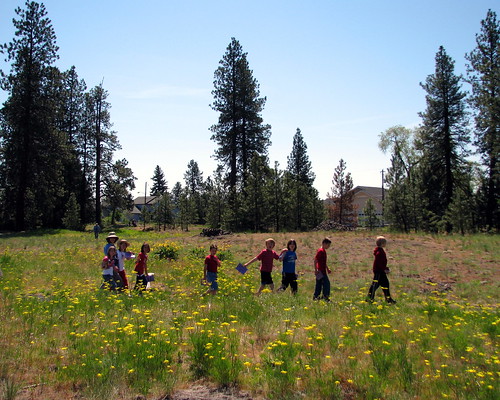
Some time later, we saw the children again as they passed through our area.
This photograph just makes me happy. The young children are walking through the beautiful root fields, surrounded by bright yellow flowers and sunshine. As I watch them, I pray in my heart that they learn to love the land, the plants, and the animals of this place the way I do. Hopefully my small efforts today will help.
Cultural Guide
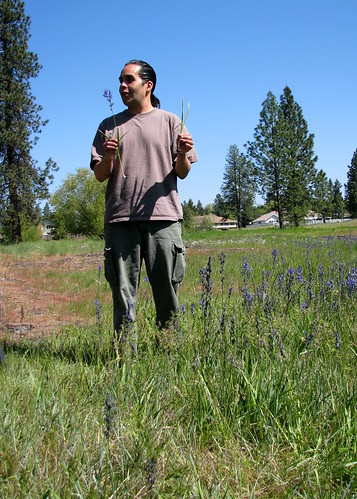
While our small student group explored the camas fields, another larger group arrived from Finch Elementary. We hadn't planned to meet any other people, but the moment was perfect. "Coincidentally," they had come to the same place to learn about Native plants and joined our group just as I was explaining the cultural significance of camas. I got to act as a cultural guide for many more people than I ever expected, and the new group was just as interested. They snapped pictures with their cameras and asked questions.
In that moment, a man arrived with a video camera to make a small documentary for Community-Minded Television and filmed most of my talk. By that point I began to wonder if some Higher Power coordinated this surprise meeting of people.
Camas
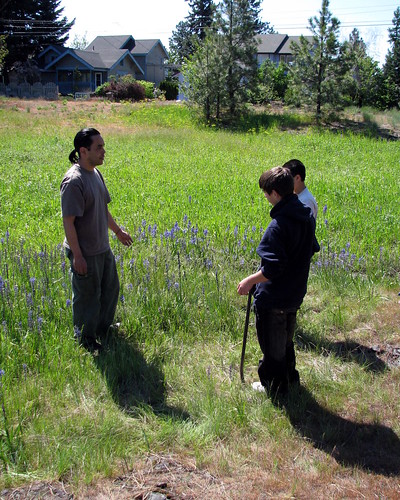
Yesterday morning, I had the opportunity to lead a small group of students in an etra-credit field trip to learn more about native plants. Only a handful of Dakota's classmates made the trip, along with their teacher, and two parents. Despite the small group, we had a wonderful experience.
I lectured briefly on the cultural history of the location, and then explained the traditional uses of brown camas. Perhaps one of the more fascinating bits of information about this plant is the cooking method used by early peoples. Since ancient times, Native people in this region prepared brown camas by cooking it in pit ovens for three days. But why three days? How did they arrive at that number?
Modern science sheds new light on this ancient practice. As it turns out, camas is filled with a complex sugar known as inulin, which is completely indigestible to the human body. A person could eat buckets of raw camas with no nutritional benefit whatsoever. However, if a person bakes camas for an extended period of time, about three days actually, the inulin breaks down into a simpler form that is nutritious and life-sustaining to humans.
Of course, our ancestors may not have explained their method in this manner, but they possessed this essential wisdom anyway. Some have suggested that they arrived at this complex understanding through a process of trial and error. Perhaps. But I also think they once possessed a much closer connection to the spirit of the plant. I know through personal experience that the plants and animals are able to communicate in ways that would surprise most modern people.
As an aside, I found an interesting account of the etmyology of the word camas. By the most reliable account I could find, it was originally a Nez perce word, first encountered in English by the Lewis and Clark expedition. Click HERE to read the account.
After my introduction, I allowed each student to dig up a few small camas bulbs. I was very happy to see their enthusiasm for the project.
Thursday, March 05, 2009
Guasave

My experience as an exchange student altered the course of my life on many levels. For one, I learned to love the culture and language of Latin America. I also gained many new friends and life experiences.
In the last few weeks, I've come into contact once again with several of my old friends. We've been apart for more than 20 years, but as our friendship re-kindles, I feel drawn to return to the city of Guasave and the place I truly became a Spanish speaker.

The Church of the Rosario was built in the 1500s.