Sunday, February 26, 2012

Ice


A while back, a friend told me that he appreciates my blog posts regarding the Spokane Language and local history, but he said that he misses seeing my photography. Things have been pretty busy, but I do have a few pictures from a few weeks ago that may suffice.

Near the end of January, we experienced a storm that left Stevens County covered in a solid sheet of ice, (I was visiting friends in that part of the world). In fact, the highway was so slick that I spun out and drove into a ditch, and I was only driving five miles per hour! A drive that normally took an hour, lasted more than five.

In the photograph above, the sunset leaves a shimmering reflection over the ice.


A layer of ice formed over everything, including the windows of my car.


But once the clouds and fog cleared away, the sunset was magnificent.


As the sun slipped below the horizon, only a sliver of red light remained.

Sunday, February 12, 2012

Dakota


Dakota sang for Glenda's voice recital yesterday evening. Many thanks to Marsha Schlangen for recording the accompaniment.

McKenna and Whitney


McKenna and Whitney sang for Glenda's voice recital yesterday.

Saturday, February 11, 2012

The Creator


During the late 1800s, Father Joseph Griva translated several Catholic prayers and catechisms into the Kalispel Language. As I have mentioned before, I appreciate these translations because they provide examples of complex sentence structure in Salish. These books have greatly deepened my understanding of the language.

In this example, Father Griva wrote:

Kuemt lu gol shei lu kolinzuten z-koltz lu skusees lu tel sch-chemaskat ks chinshitems lu skeligu ie l stoligu. Lu skusees kolinzuten shei lu Jesu kri. Jesus shei unegu kolinzuten. Jesus shei negu skeligu. Jesus potu it shei kolinzuten u skeligu.

The same text in the IPA format:

kʷen't łuʔ x̣ʷl šey' łuʔ k'ʷul'ncutn ckʷulsc łuʔ sqʷseʔs łuʔ tl' sččmasq't qs čnšitms łuʔ sqelixʷ y'e l' stulixʷ. łuʔ sqʷseʔs k'ʷul'ncutn šey' łuʔ yesukli. yesu šey' unexʷ k'ʷul'ncutn. yesu šey' nexʷ sqelixʷ. yesu puti t šey' k'ʷul'ncutn u sqelixʷ.

My translation back into English:

Then for that (reason), the Creator sent his son to us from the sky to help the Indians (people) here on the earth. The Creator's son is indeed Jesus Christ. Jesus is truly the Creator. Jesus is also Indian (human). Jesus is still (continually) Creator and Indian (human). 

*

Translation is never an exact science.

Without question, the priests intended to say that Jesus is human; however, in our language, the word for human (sqelixʷ) is also the word we reserve specifically for ourselves as Indian people. In fact, after white people began arriving in great numbers, a division in the language occurred. Our ancestors retained the original human designation for Indian people (sqelixʷ) and assigned a different term for white people (suyepi). Nowadays, sqelixʷ and Indian are nearly synonymous.

Perhaps ironically, the priests declared in their own catechism that Jesus is Indian. This makes me wonder how our elders would have perceived this teaching. In my imagination, I picture them smiling and nodding in agreement, but in the back of their minds, they may have said to themselves, "Of course the Creator is Indian. We knew that all along."

And if the Creator is Indian, then we will relate to him as we always have, with our own ceremonies, prayers, and songs.

Thursday, February 09, 2012

łu tel kaimintis kolinzuten


More than 100 years ago, the Jesuit missionaries brought Christianity to the Salish-speaking peoples of the Inland Northwest, and as I've mentioned before, the main branch of my family adopted Catholicism as far back as the 1840s. It's a complex and confusing history. On the one hand, the early Jesuit fathers mastered the Salish languages to an amazing degree of fluency. They even published books in the language! But a generation later, Catholic schools were punishing Indian children for speaking anything other than English. What a bizarre irony of history! They meticulously documented the language, only to later encourage its eradication.

The contradiction is unfathomable, but at the end of the day, I really am grateful that the priests wrote about their experience of the Salish language. More than a century later, their writings have both supported and deepened my own learning process.

In 1879, the Missionaries of the Society of Jesus published a compilation of Bible stories written in the Kalispel Language: łu tel kaimintis kolinzuten (From the Writings of the Creator). To my knowledge, they never attempted a complete translation of the Bible into any interior Salish language, but kaimintis kolinzuten is perhaps the most complete Biblical text ever written in a local dialect. It includes all the major stories of the Old Testament, along with a thorough summary of the four Gospels.

Of course, the priests did not have the benefit of our current writing system, sometimes known as the American Phonetic Alphabet or the International Phonetic Alphabet. They invented their own system of writing based upon a simplified version of the Roman letters. Their writing was difficult for me to understand at first, but once I learned a few basic substitutions, I found that it was relatively easy to decipher.

For example, the priests used the letter 'g' to indicate most of the 'x' or 'xʷ' sounds. They also used the letter 'z' to represent the 'c' or the glottalized 'c'.

The following is a sample of the text, followed by a transcription in the current writing system and a tentative translation into English:

T-KOLINZUTEN kólis łu s'chchmáskat, u łu stóligu. U łu stóligu i choólegu ... łu lesshii̓ti sgalgált, zúti: Kskol'li łu spaáka, u kolil łu spaáka ...

t k'ʷul'ncutn k'ʷul'is łuʔ sččmasq't, u łuʔ stulixʷ. u łuʔ stulixʷ i č'uw'leʔxʷ ... łuʔ l' hecšʔiti sx̣lx̣alt, cuti: qs k'ʷul'l'i łuʔ sp̓aʔaq, u k'ʷul'l' łuʔ sp'aʔaq ...

The Creator made the sky and the earth. And the earth was a deserted place ... On the first day he said: Let the light be born (made), and the light was born (made) ...

Of course, it is important to note that a person could not really learn to speak the language using only the Jesuit text. The letters are relatively consistent, but the sounds are not precise. Having said that, the text provides a valuable resource to anyone who already has a solid understanding of the modern writing system. With a few substitutions, I have been able to read and understand the writing and thereby answer a few long-held questions about grammar and sentence structure. And since the Spokane Language is so similar to the Kalispel, these books provide crucial insights into my own understanding of Salish.

Saturday, February 04, 2012

Broadway Night


Dakota sang an amazing rendition of They Live In You (from the Lion King) at Mead High School's Broadway Night. It was a brilliant, inspirational performance - with goose bumps and all. As always, my son makes me proud.

Thursday, January 19, 2012

Snow


ho....y čicntm łuʔ sʔistč y'e n sƛx̣etkʷ. xʷeʔit hec mox̣ʷpmi y'etłx̣ʷa, u xʷeʔit łuʔ sm'ek'ʷt y'e n stulixʷ. yoyot čn lemt x̣ʷl n̓e sqepc, m qe tixʷ t sewłkʷ x̣ʷl qe sqelixʷ sʔiłn... łuʔ sp'eƛm, łuʔ p'ux̣ʷp'ux̣ʷ, łuʔ st'šałq... hecya stem'.

kʷen y'e sč'łq'ʔincut č' čsax̣m łuʔ ntx̣ʷetkʷ.

Tuesday, January 17, 2012

Ancestors


y'e kʷiƛ̓t sč'łq'ʔincut tl' int'upyeʔ Leyton Moses, nexʷ łuʔ p'x̣ʷp'x̣ʷuc. Joseph Moses łuʔ m'estm's u Ellen łuʔ tum's. q'ʔintem łuʔ skʷesc t q'ʷaylqs Father Connolly, nexʷ łuʔ snqlixʷskʷesc. ec'x̣ił q'ʔintes łuʔ q'ʷaylqs: Qui-métqu łuʔ Leyton snqlixʷskʷesc. Seésh-shm-ta łuʔ Ellen snqlixʷskʷesc. łuʔ Joseph Moses ƛ̓m epł esel  snqlixʷskʷest (šey' cuti łuʔ q'ʷaylqs): Ch-tóh-see u Pah-ko-tés.

ta hec misten lčen u qeqs q'ʔintem łuʔ skʷesc y'etłx̣ʷa.

Another photograph of my great grandmother Leyton Moses, along with her parents. Joseph Moses was her father and Ellen was her mother. Their names were written by the black robe (priest) Father Connolly, and also their Indian names. This is how the priest wrote: Qui-métqu was Leyton's Indian name. Seésh-shm-ta was Ellen' Indian name. Joseph Moses had two Indian names (according to the priest): Ch-tóh-see and Pah-ko-tés.

I do not know how we would write their names now (in the modern Salish alphabet).

Leyton


łuʔ in t'upyeʔ Leyton Moses u łuʔ stmčʔelc Nellie Pichette.
My great grandmother Leyton Moses and her daughter Nellie Pichette.

Saturday, January 14, 2012

Mary Walker


Several days ago, I held in my hand a most extraordinary book - an original hand-written Spokane dictionary compiled by Mary Walker sometime between 1838 and 1848. The book was constructed from several folded sheets of paper that were bound together by a simple black thread. The pages contained a random mix of words written in both ink and pencil, along with an assortment of streaks and household stains.

I was actually surprised they allowed me to handle an original document from the 19th century.

This hand-written dictionary resides in the Northwest Room of the Spokane Public Library. Before I was allowed me to view the book, I had to sign a special agreement that included my driver's license number and other identifying information. With all the paperwork complete, the librarian simply handed me a folder that contained the original book.

*

Elkanah and Mary Walker lived among the Spokane people from 1838 to 1848. The American Board of Commissioners of Foreign Missions sponsored the Walkers as missionaries to convert the Spokane to Christianity. After following the Oregon Trail to Walla Walla, they eventually settled in a place called Tshimakain, near present-day Ford, Washington.


The Walkers lived among the Spokane for nine years, but never made a single convert. Their failure to win souls for Christianity perhaps stemmed from their ethnocentric view of religion. The Walkers demanded that the Spokane not only abandon their existing spirituality, but also adopt a European, agrarian lifestyle. How farming became a requirement for salvation, I'll never know. But their diaries also suggest that both Mr. and Mrs. Walker often expressed contempt for Native customs, beliefs, and traditions.

Years ago, I remember reading that Mrs. Walker sometimes scolded the Spokane for what she perceived as sinful behavior - things like practicing Indian medicine or 'stealing' from her garden. Some parts of her dictionary seem to reflect a basic misunderstanding of the culture and a focus on negative behavior. In fact, the initial three words on the cover page are: to steal, to lie, to hide away.

It is easy to see why the mission failed to gain converts.


Despite the apparent ethnocentrism, Mary Walker's dictionary offers some insight into the origins and development of the Spokane Language. For example, the second page contains the Spokane word for the soul: sinhupows. Mrs. Walker created an improvised spelling system, but still the word bears an obvious resemblance to the correct pronunciation: snx̣pew's.

The appearance of this one word inspires an interesting question in my mind. For several years, I have heard the story that the Spokane word for the human soul was a creation of the Catholic missionaries, and yet Mary Walker may have recorded that word as early as 1838, several years before the priests even arrived in the area. My family did not become Catholic until some time between 1842 and 1845. The Protestant and Catholic missions did overlap somewhat, so it is possible that they shared a common vocabulary, but I have to wonder if Calvinist missionaries would accept a Catholic description of the soul.

Another interesting word that she recorded was a word for spirit: Npupowlish's. This word is similar to the word npupewlštn, which has reference to the breath. Once again, this makes me wonder if that was an original Spokane concept of the spirit or a Christian innovation.

*

I cannot say that Mary Walker's Spokane Dictionary added to my vocabulary - her book was really nothing more than a word list - but it inspires me to see a written account of the Spokane Language from almost 175 years ago.

*

The Walkers abandoned the mission shortly after the Whitman Massacre in 1847. Some time later, Mrs. Walker composed a poem to remind her children of their birthplace among the Spokane:

Tshimakain! Oh, how fine, fruits and flowers abounding,
And the breeze, through the trees, life and health conferring.
And the rill, near the hill, with its sparkling water
Lowing herds and prancing steed round it used to gather.
And the Sabbath was so quiet and the log house chapel
Where the Indians used to gather in their robes and blankets.
Now it stands, alas forsaken: no one with the Bible.
Comes to teach the tawny skailu (people) of Kai-ko-len-so-tin (God)
Other spots on earth may be to other hearts as dear;
But not to me; the reason why, it was the place that bore me.
 
*
 
Notes:
 
1. The correct spelling of people is sqelixʷ.
2. The correct spelling of Creator (God) is k'ʷul'ncutn.
3. The poem is quoted from:
 
http://www.historylink.org/index.cfm?DisplayPage=output.cfm&file_id=7204.

Wednesday, January 11, 2012

The MAC


This morning I paid a visit to the Northwest Museum of Arts and Culture (the MAC) to lead a student group from an ESL class (English as a Second Language). The students represent a variety of cultures, but the majority have come to the United States from the Himalayan nation of Bhutan.

The Bhutanese students surprised me because of their deep interest in the various exhibits. For example, as we observed several large baskets, one middle-aged woman became somewhat emotional as she explained that many years ago, her father had made a similar basket. Almost every time I have spoken to the Bhutanese students, they remark how similar their culture is to the indigenous people of North America.   


Every item displayed a deep sense of beauty. Every basket, mocassin, or beaded bag reminded me of friends and loved ones who continue to make such things, and while I certainly understand the desire to preserve them, it was difficult for me to see them as simple artifacts. Yes, I appreciate the beauty, but at the same time, I feel sad to know that these items will never be used again.

In the old way, I have heard it said that certain objects sometimes come alive, like a spirit. I wonder then, how these ones feel living always behind a layer of glass.


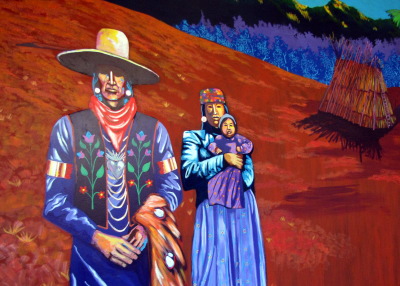
The lobby features a large mural painted by local artist Ric Gendron. I have to say that I have always loved his work. In my experience, his paintings reflect the soul of Indian people in this region. They evoke something deeply inspired and authentic, and they reflect tradition, while accepting the complexities of culture and history.

Sunday, January 08, 2012

etwan


Eighteen years ago today, my father left this world. He would have been 64. Since these anniversaries never seem to leave my heart, I must still have some need to observe his memory and his vision for the world. During the last ten years of his life, he worked hard to promote the traditional ways of our ancestors. He traveled all around the Pacific Northwest and learned from elders in several different Indian communities. He cooked for traditional gatherings and revived many of the old songs.

If he were alive today, I have no doubt that he would be very happy to witness our efforts to re-vitalize the Spokane language.

*

Just the other day, I was thinking about how Native languages are lost over time. Many of our elders once believed that the Indian ways were a thing of the past, so they taught their children to speak only English. In my family, my father was the first generation to learn English as his first language, meaning that I am only the second generation removed from the world of my Salish-speaking ancestors. His parents and grandparents certainly knew English as a matter of convenience or perhaps necessity, but they spoke Salish first. When I consider the 10,000 year span of history in this region, two generations do not seem like a long time.

English was also my first language, but a remnant of the old language persisted.

A scattering of Salish words punctuate the memory of my childhood. For example, some of my earliest memories revolve around asking my father for permission to do one thing or another, and he would often respond by saying, "xʷuyš!" which means, "Go!"

Other times, we followed a strange ritual around driving the car. Where ever we went, my father always sat behind the wheel, but whoever sat in the front passenger seat had the solemn responsibility to watch for cars on the right side of the vehicle. If we came to an intersection, my father would never look to the right. He only looked to the left, which I suppose he regarded as his special domain. With complete trust in the navigator, he always asked, "How is it?" The navigator would then look to the right and decide if it was safe for the car to enter the intersection. If other cars were approaching, the passenger would say, "Wait," but if the road was clear, he would say, "miš," (This means literally: "It is empty.") Upon hearing that word, my father drove forward onto the highway without pausing or making a second thought. In a way, our safety depended on that one word.

From my childhood, I also remember that my elders sometimes asked, "stem' a spuʔus," which was a way of asking, "How are you?" But it literally means, "What's on your heart?" Other words also survived, like yaya (grandmother), sileʔ (grandfather), suyepi (whiteman), or lemlmtš (thank you), but I have no idea why some persisted into our English-speaking world and why others went dormant. 

A while ago, I was also wondering which of all the Salish words was the first to enter my permanent memory. I reflected on this question for several days, and I finally concluded that the earliest word from my childhood is actually my father's name: etwan. A long time ago, our Salish-speaking elders once created Indianized versions of English names - names like misel for Michael, tapit for David, malian for Mary Anne, and etwan for Edward. Some families continue this practice today.

I have virtually no clear memories of my yaya Minnie (my father's mother), but I can still see her in my mind sitting in a chair with a blanket wrapped around her shoulders. I don't remember anything else, except that she called for my father, "etwan, I'm cold. Put some wood in the fire."

*

On this day, eighteen years after my father's passing, I am somehow comforted to know that his name was the first word I can remember learning in Salish. Like a seed left over from a previous generation, that name is a source of power and the beginning of possibilities yet to come.

*

(Salish has no capitalization, so these names are written with all lower case letters).

Saturday, January 07, 2012

Whitney's Audition


Whitney also auditioned for CYT Spokane's Oklahoma and did a wonderful job.

Dakota's Audition


Dakota auditioned for CYT Spokane's upcoming production of Oklahoma. He just gets better and better. I am very proud.

Endangered Cultures


A brilliant TED video recommended by my friend Maggie Dale shows the wonder of cultural diversity within the 'ethnosphere,' especially among indigenous cultures. This video highlights what is lost when the forces of industrialzation overwhelm native peoples; language, culture, and a unique understanding of reality.

Thanks Maggie!

Sunday, January 01, 2012

The New Year


My elder once told me that the old time Indians looked at the new year like a spirit, and as each new year arrived, they always asked him to bring good things and to not leave the people in a pitifual way. This is my prayer for the new year. I didn't make any grand resolutions beyond my desire to recognize the blessings of being alive with my family and friends.

Encore


My family participated in CYT's yearly Encore Encore performance at the Bing Crosby Theater. The kids got to perform select encore numbers from Music Man and Annie, and I got to be King of New York just one more time. After the show, we took a few family photographs on the stage of the theater.


We're looking forward to the upcoming shows of the New Year.

Family


My sister bought a house last year, so this Christmas the family gathered for dinner in her home. We made Italian food, played games, and took the first family photo in several years. What a wonderful time!

Click on the photograph to enlarge.

Monsters


Christmas and the New Year have already passed, and we take one last breath before diving back into the hectic world of work. But this Christmas season was hectic in its own way, with all the shopping, running around, visiting, and in my case, making home-made gifts.

In particular, my daughter loves Ugly Dolls. I have only ever been able to find them at Boo Radley's in downtown Spokane, along with a hundred other bizarre little items. This year, I decided to make my own monster doll. I suppose it means more when it comes from your own heart and hands.

As expected, my daughter loved this doll more than all the others.


The pattern was my own creation.


The doll was named Skalula, after a Native American monster song from the Okanogan country.

Sunday, December 11, 2011

Wild Food


My friend Matthew completed a rather unusual and creative project by eating only wild foods for an entire month. The challenge initially began as a way to save money on store bought food, but it expanded into a school project. He described some of his experiences on a personal blog:


A small group of supporters gathered to celebrate the conclusion of his wild food challenge. For my part, I personally support his project because of my interest in native foods and because I wish to encourage people to become more aware of their natural environment. The more we learn about the living things growing on our lands, the more we feel inclined to protect those lands.


Our menu for the evening included wild turkey, boiled amaranth seeds, venison soup cooked with home grown carrots and beets, and a cobbler made with huckleberries and apples from an abandoned, 'wild' tree, topped with a crust made from cattail flour and ground curly dock.

Choir


After several years of homeschooling, Dakota has returned to the mainstream high school. So far things seem to be going well for him. Participating in the choir has made the transition a little easier.

Monday, November 28, 2011

Completion


Several weeks ago, Dakota finished his eagle project. Some folks were interested in seeing the end result, so I am posting these photographs for their benefit. I have to say that things turned out well. My son has made me very proud.


Friday, November 25, 2011

Thanksgiving


On Thanksgiving morning, I attended an inter-faith service at Temple Beth Shalom where representatives of several faith traditions spoke about faith, gratitude, and peace among diverse peoples. The service was sponsored by the Spokane Interfaith Council, Second Harvest of Spokane, and Temple Beth Shalom.


Rabbi Michael Goldstein led the service.


Before the service, I asked permission to take photographs inside the synagogue. The rabbi gave permission for pictures on any day, except for the Sabbath (Saturday). These prayer shawls were hanging inside the cloak room of the temple.


Sister Mary Euchrista represented the Catholic faith. It was a happy reunion for me because years ago, she completed her student teaching in my classroom at the Medicine Wheel Academy.


Mona Ali represented the Muslim community of Spokane.


Geshe-la also spoke during the ceremony and represented Tibetan Buddhism.


Hebrew writing was displayed in the temple lobby.

LinkWithin

Related Posts with Thumbnails