Sunday, February 09, 2014

Wedding


On Saturday, my Uncle Pat asked me to help sing 
for the wedding of Dawa Numkena and Sherrie SiJohn
in the Jesuit Chapel on the campus of Gonzaga University. 

It was a beautiful service.


The bridemaids...


The ring bearers and groomsmen...


Mosaic behind the altar...


Father Jack performed the wedding.


After the vows, the couple was presented with a blanket. 


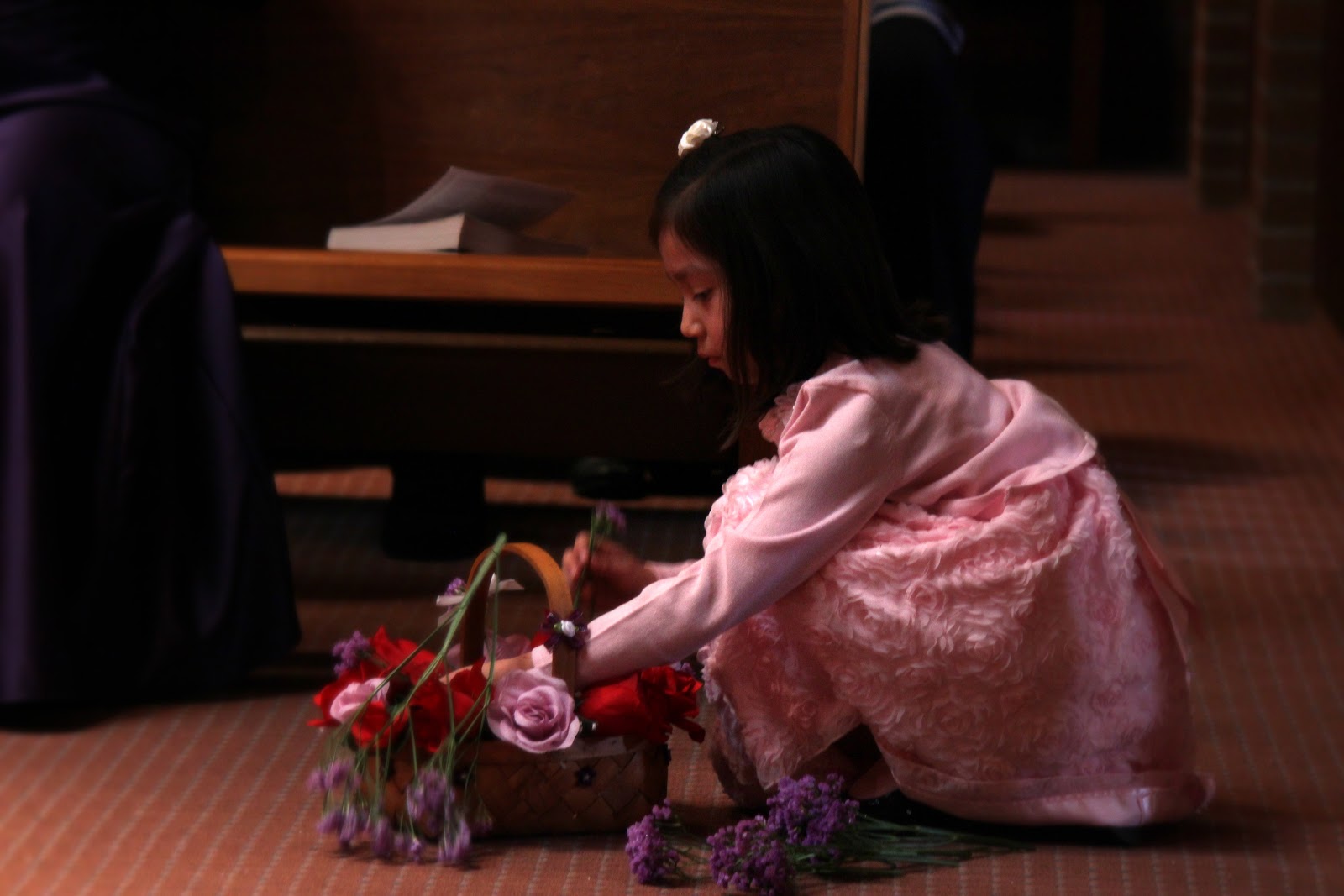
Flower girl...


The wedding party...


Stained glass window 
depicting a priest holding a cross.


A depiction of Christ
wearing a papal tiara.


A priest holding the communion emblems.


Gonzaga Crest...

Wednesday, February 05, 2014

Dawn


You are the sum total 
of all that we have been.

Years ago, my high school English teacher assigned me to read Elie Wiesel's "Night," an autobiographical account of the author's experience in a Jewish concentration camp. I visited the high school library and checked out a different book by mistake: "Dawn" (by the same author).   

"Dawn" is the fictional account of Elisha, a young Jewish patriot who joined a movement to expel the British Empire from Palestine and to create a Jewish state. He was assigned by the leader of the movement to execute a British hostage the following morning at dawn, and throughout the night, he agonized over his impending descent into murder. As the hour of the execution approached, he was visited by the spirits of his deceased parents, along with other shadows from his past. He thought it strange that his dead relatives would return to watch him kill the English hostage. They responded that they wanted to see him become a murderer, and they told him the reason for their unexpected desire: "You are the sum total of all that we have been." 

This book had a profound effect upon me. It forced me to re-examine my judgments regarding good and evil. 

Recently, I re-read the book during my trip to Cleveland, and I have to say that it affected me even more than before. It caused me to reflect upon my own decisions in life. When the spirits of my ancestors look upon me, what do they see? If I am the sum total of all they have been, who then have we become? 

Tuesday, February 04, 2014

Cleveland


After the cultural gathering near Kirtland, 
we had a community dinner in Cleveland. 


We met in a house that was once an old store. 


Friends bring love and laughter.


Even though poverty is a constant companion in this neighborhood. 


Hundred year old store fronts line the streets. 


A tattoo parlor across the street...


But friends are an oasis of hope...


A homegrown church on the street corner. 

Iglesia Roca de Refugio
"Rock of Refuge Church"

When I took this picture, 
I heard someone
tuning an electric guitar. 
I wish I had more time 
to visit their worship service.


A flowering tree covered with snow. 
Did he say it was a tulip poplar?

Monday, February 03, 2014

The Kirtland Temple


On Friday morning, I had only barely recovered from a withering bout of bronchitis, when I boarded a plane for Cleveland, Ohio. My friends invited me to attend a cultural gathering that included people from the Anishanaabe, Cree, and other tribes. 

Ironically, a major portion of the gathering happened just a few miles down the road from the Kirtland Temple.  

The Kirtland Temple was the first such structure built by Joseph Smith and the Latter-Day Saint movement. The early Mormon saints carved the temple from the wilderness in the early 1830's when that portion of the state was still relatively wild and heavily wooded. Despite their own poverty, they sacrificed their material comfort to build a suitable house of worship. The temple was dedicated in 1836 amid an outpouring of spiritual manifestations.   


This was also a place of spiritual irony. Scarcely a generation before the Mormons took refuge in Kirtland, the Native American tribes of the Ohio region were devastated by the invasion of land-hungry settlers. Ohio became a state in 1803, but a few scattered survivors remained until the Indian Removal Act of 1830. The decline of Indian civilizations overlapped with the rise of Mormonism and the American frontier. 


Kirtland also represents a mystical, charismatic version of Mormonism from a bygone era. The early saints embraced a revolutionary faith that challenged conventional orthodoxies and dared to suggest that ordinary people had access to the divine through direct, personal experience. On the day of the temple dedication, people reported seeing angels walking on the rooftop. Some heard the sound of a rushing wind, while others spoke in tongues. The most faithful even reported seeing Jesus standing in bodily form on the breastwork of the pulpit. This was a youthful, exuberant faith, still untouched by the bureaucracy that would eventually transform the modern church into an institution defined in part by its uniformity and doctrinal conservatism.  


How strange to think that the people and events of Kirtland began a movement that changed the world, a movement that would eventually affect my family, my children, and my community. 


Finally, this last photograph is actually my favorite of all the ones I took that day. Unlike the idealized, picture-perfect renditions of the temple from official church publications, this photograph shows the temple in its natural setting - crowded by asphalt, the cacophony of passing cars, and a tangle of electrical wires. Here the ineffable and the mundane exist side by side, each one touching the other. 

Thursday, January 30, 2014

Snow


Dakota asked me to post pictures of the snow. 

The first picture is the snow on 
a yarrow plant in our back yard. 


The tree in our back yard. 


Our back fence. 


My face after sleeping three days with bronchitis. 


The puppies playing in the snow. 

Wednesday, January 29, 2014

The Sunflower


The Sunflower

We have been asked to read The Sunflower: On the Possibilities and Limits of Forgiveness as part of our class in Leadership, Restorative Justice, and Forgiveness. 

The Sunflower is an autobiographical account by Simon Wiesenthal, a Jewish man condemned to a Nazi concentration camp during the Second World War. The story takes its name from the sunflowers that he saw growing on the graves of Nazi soldiers. The flowers reappeared as a recurring theme, and symbolized the unthinkable disparity between the aggressors and the victims of war. He wrote hauntingly, "Suddenly I envied the dead soldiers. Each had a sunflower to connect him with the living world, and butterflies to visit his grave. For me there would be no sunflower. I would be buried in a mass grave, where corpses would be piled on top of me. No sunflower would ever bring light into my darkness, and no butterflies would dance above my dreadful tomb" (Wiesenthal, 1969/2008).

The primary dilemma of the story emerged when he was summoned to a military hospital and ushered to the death bed of a wounded SS soldier. The dying man grabbed Wiesenthal's hand and then offered his last confession, almost by force. As he unburdened his soul, he confessed to participating in the mass killing of Jews. He was haunted by one experience in particular when his unit locked several Jewish families into a house, then set it ablaze with hand grenades, while they stood guard outside. One family, including a small child, jumped from the burning house, and were gunned down by the soldiers.

The dying SS man sought absolution by confessing his crime to a Jew, any Jew who would listen. He wanted to die in peace, but Wiesenthal responded with silence. He could not bring himself to speak. 

After telling his soul-wrenching story, Wiesenthal asked, "Was my silence at the bedside of the dying Nazi right or wrong?" (p. 97). He did not respond to his own question; rather, he left the question for others to address. He wrote, "You, who have just read this sad and tragic episode in my life, can mentally change places with me and ask yourself the crucial question, 'What would I have done?'" (p. 100). 

In the second half of the book, dozens of philosophers, theologians, and political leaders offered their responses to this poignant question, with many of the responses contradicting one another. 

Few books have affected me as much as Simon Wiesenthal's The Sunflower. It speaks to the heart of justice and forgiveness, but it offers no easy solutions - no tidy answers. I am left in the darkness of my own soul to respond to Wiesenthal's challenge: "What would I have done?" 

And now that you've read my post, what would you have done? Perhaps you will respond in the comments. 

*

Note: The photograph in this blog post was taken at Lincoln Park in Spokane, WA. The flowers are arrowleaf balsamroot, not the sunflowers that Simon Wiesenthal would have seen in the military cemetery. 

References:

Wiesenthal, S. (2008). The sunflower: On the possibilities and limits of forgiveness. [Kindle version]. Knopf Doubleday Publishing Group: New York. (Original work published 1969)

Monday, January 27, 2014

Marie


My relative Marie Grant celebrated her 90th birthday yesterday at Northern Quest. She and I both descend from the Chewelah band of the Kalispel Tribe, and from the same common ancestor. We have occasionally collaborated on our family tree, and she has encouraged me in our traditional ways. She is a beautiful woman, a gifted historian, and a cherished elder. I'm proud to know her. 


Hundreds of people honored Marie. 


Several of us were invited to sing an honor song.  


JR Bluff announced the drum as: 
the Frog Island and Miscellaneous Singers. 

Sunday, January 26, 2014

The Dark Side of Venus


Two nights ago, I dreamed that I embarked on a long journey to the south, but a wickedly powerful dust storm blocked my path. This kind of storm seemed more suited to Arizona or some other desert location, but not Spokane. The image of my home town covered in billowing clouds of hot sand was surreal and otherworldly. 

For a while, I battled the blinding sand, but I finally stopped. Then I got angry and found my clarity. I said, "Why should these storms block my path when I can fly?" 

Like a rocket, I flew straight up into the sky. I passed through the heart of the sand storm, and eventually emerged through the top of the clouds. When I broke free of earth's atmosphere, the stars appeared in brilliant clarity. It was an awesome sight!

But then the spirit said, "There's something you have to see." 

Still flying like a rocket, I was led to the planet Venus. I settled into a low orbit, and when I looked down, I saw the burning, tumultuous clouds of the second planet in our solar system. I was mesmerized by its fiery beauty, but the spirit said, "You need to see the storm brewing on the dark side of Venus." I continued toward the other side of Venus, and I was amazed to see massive flashes of lightning that cracked the face of darkness.  

Image: J. Whatmore. 

Saturday, January 25, 2014

Being Human


We are human because we belong...
...no one can be human alone.

~Desmond Tutu

Forgiveness


True reconciliation is not cheap. Forgiving and being reconciled are not about pretending that things are other than they are. It is not patting one another on the back and turning a blind eye to the wrong. True reconciliation exposes the awfulness, the abuse, the pain, the degradation, the truth. It could even sometimes make things worse. It is a risky undertaking but in the end it is worthwhile, because in the end dealing with the real situation helps to bring real healing. Spurious reconciliation can bring only spurious healing.

~Desmond Tutu


Friday, January 17, 2014

kn səcqisx


This is freaking awesome!!! These children recited Dr. Martin Luther King's "I Have a Dream" speech in the Colville-Okanagan language. They held my attention to the very end, and now I want to do a Spokane version: čn ep sqeys...

kÊ·tunt lemlmtš Salish School of Spokane!!! unexÊ· qÊ·amqÊ·mt!

Thursday, January 16, 2014

Restorative Justice


This semester, I am taking a course at Gonzaga University called Leadership, Restorative Justice, and Forgiveness. So far, the course has been an exploration of the restorative justice model proposed by the Truth and Reconciliation Commission of South Africa that recommended reparations for victims of Apartheid and amnesty for offenders who made a full confession of their wrongdoing. This model is radically different than the retributive justice model we tend to favor in the United States, but I am open to learning more.  


Consider the following quote from Archbishop Desmond Tutu: 

"We contend that there is another kind of justice, restorative justice, which was characteristic of traditional African jurisprudence. Here the central concern is not retribution or punishment. In the spirit of ubuntu, the central concern is the healing of breaches, the redressing of imbalances, the restoration of broken relationships, a seeking to rehabilitate both the victim and the perpetrator, who should be given the opportunity to be reintegrated into the community he has injured by his offense."


Tutu also wrote, "In the process of dehumanizing another, in inflicting untold harm and suffering, inexorably the perpetrator was being dehumanized as well .... They need us to help them recover the humanity they have lost."


Desmond Tutu mentioned that the restorative justice model was based in traditional African cultures. This makes me wonder what model of justice was accepted by the pre-contact Salish. 


These photographs were taken
near East Valley Springs Road
between Little Baldy and Beacon Hill.

Tuesday, January 07, 2014

Dominic


So many people have worried, cried, prayed, and sent positive thoughts for the recovery of my cousin, so I am happy to report that he is making a dramatic improvement. When I visited the hospital this afternoon, he was sitting on the end of his bed and talking with the nurse. He recognized me right away, shook my hand, and then gave me a hug. What a remarkable change! 

We spoke for about twenty minutes, but he doesn't remember much of what happened. 

As I left his hospital room, he gave permission to send this picture to everyone who has expressed concern. He hugged me again and said, "Love you cousin." 

Compassion


Compassion emerges 
from imagining the world alive.

~ Alexandra Horowitz

On Looking: Eleven Walks with Expert Eyes 


(Photographs from Holy Family Hospital in Spokane, 1/7/14)

Gray


The snow arrived suddenly and cast a gray shadow over the world. It reminded me of another quote from Owning Your Own Shadow: "To honor and accept one’s own shadow is a profound spiritual discipline. It is whole-making and thus holy and the most important experience of a lifetime."

(Photograph from the Hillyard Adult Education Center, 1/7/14).

Monday, January 06, 2014

Red Earth


Shelly Boyd, this post is dedicated to you. This is a painting I did last year with my own homemade mixture of tulmn (red earth) and gum arabic. You said you wanted to see me make a tulmn painting, and here it is. Maybe some time you can claim your painting, put it in a frame, and hang it on your wall. 

Sun Dogs


Sun dogs were visible in the sky this afternoon. 

LinkWithin

Related Posts with Thumbnails